Advertisements
Advertisements
प्रश्न
Explain the process of translation.
Advertisements
उत्तर
Translation: Translation is the process in which the sequence of codons on the mRNA strand is used (read/decoded) and accordingly the amino acids are joined to each other to form a polypeptide chain that makes protein.
The process involves the following steps:
- Activation of amino acids and formation of AA-tRNA complex: In the presence of an enzyme aminoacyl tRNA synthetase, the amino acid (AA) molecule is activated and each amino acid is attached to the specific tRNA molecule at 3'/CCA end to form aminoacyl-tRNA complex. The reaction requires ATP. This process is called charging of tRNA or aminoacylation of tRNA.
- Formation of the polypeptide chain: It is the actual translation which involves the following steps:
- Initiation: It begins with the formation of the initiation complex which requires the mRNA having codons for a polypeptide, the smaller (30S) and larger (50S) subunits of the ribosome, the initial AA1 tRNA complex and ATP and GTP as a source of energy. The process of initiation needs initiation factors.
In prokaryotes, the first AA1-tRNA complex has an amino acid, N-formyl-methionine (f-met); In eukaryotes, it is methionine (met). The process starts with binding of mRNA on the smaller 30S subunit of the ribosome. The start codon AUG is positioned properly. The AA1-tRNA complex, i.e. f-met-tRNA complex now gets attached to the start codon AUG. This is done with the help of anticodon UAC of tRNA. Small and large subunits of ribosome join to form 70S ribosome. The ribosome has three sites namely, Aminoacyl site (A), Peptidyl site (P) and Exit site (E). The empty tRNA leaves from the E site. Only the AA1-tRNA complex binds at the P site directly, while all the other incoming tRNA complexes get attached first at the A site and then are shifted to the P site. The polypeptide chain is released from the P-site. In eukaryotes, the 40S (smaller subunit) and 60S (larger subunit) combine to form an 80S type of ribosome.
- Elongation: This is done by the formation of peptide linkages/bonds in between the successive amino acid molecules (AA1, AA2, AA3 and so on). The elongation activity is catalyzed by the enzyme peptidyl transferase. Each tRNA complex brings a specific amino acid. Due to the complementary nature of anticodons and codons, the amino acids are placed in their proper positions. During elongation, the ribosome moves along the mRNA in a stepwise manner from start to stop codon (5'→ 3'), one codon ahead each time. This movement is called translocation. In every step of translocation, one amino acid is added to the polypeptide chain causing elongation.
- Termination: When the mRNA reaches the last termination codon, i.e. either UAA, UAG or UGA, termination occurs. In identifying the stop/termination codon and in releasing the polypeptide chain from the site, the release or termination factors R1, R2, and S play an important role. After termination, the smaller (30S) and larger (50S) subunits of the ribosome get separated from each other. In order to increase the cellular efficiency of protein synthesis, many ribosomes may bind to the mRNA strand and form the polypeptide chain for the synthesis of the protein molecule. Such a structure with many ribosomes bound to mRNA is called a polysome or polyribosome.
- Initiation: It begins with the formation of the initiation complex which requires the mRNA having codons for a polypeptide, the smaller (30S) and larger (50S) subunits of the ribosome, the initial AA1 tRNA complex and ATP and GTP as a source of energy. The process of initiation needs initiation factors.
APPEARS IN
संबंधित प्रश्न
Which process is shown in the following diagram?

____________ refers to the process of copying of genetic information from one (template) strand of DNA into a single stranded RNA transcript.
Study the following sentences and select the correct option.
- Addition of one or two bases changes the combination of sequence in codons.
- Addition or deletion of single nucleotide changes the reading frame.
- The reading frame beyond the point of insertion of three bases remains unaltered.
The mRNA AUGCAGAUACGC recognizes four amino acids and this character of the code referred to as ____________.
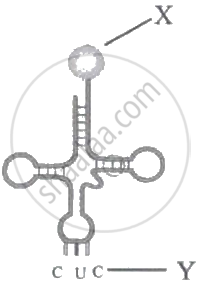
What does 'X' and 'Y' represent in the following diagram oft-RNA molecule?
Identify the INCORRECT statement.
Match the Column I (RNA polymerases) with Column II (Transcribed products) and select the correct option.
| Column I | Column II | ||
| i. | RNA polymeraseI | a. | t-RNA |
| ii. | RNA polymerase II | b | rRNA |
| iii. | RNA polymerase III | c. | hnRNA |
Select the correct option from the following:
In a translation experiment, two different mRNAs with different nucleotide sequences used are as follows:
mRNA 1:
5' AUG UUU UUA UUU UUA UAA UUC UUG - 3' and
mRNA 2:
5' AUG UUC UUG UUA UUU UAG UUU UUA CUU - 3'
From the following identify the TRUE statement.
Which one is a cell-coded protein formed in response to infection with most animal viruses:
Which one of the following is not applicable to RNA?
