Advertisements
Advertisements
प्रश्न
Explain the phenomenon of electromagnetic induction. Describe an experiment to show that a current is set up in a closed loop when an external magnetic field passing through the loop increases or decreases.
Advertisements
उत्तर
The process, by which a changing magnetic field in a conductor induces a current in another conductor, is called electromagnetic induction. In practice, we can induce the current in a coil either by moving it in a magnetic field or by changing the magnetic field around it.
Experiment
Take two different coils of copper wire having a large number of turns (say 40 and 90 turns respectively). Insert them over a non-conducting cylindrical roll, as shown in the figure given below. Connect the coil-1, having a larger number of turns, in series with a battery and a plug key
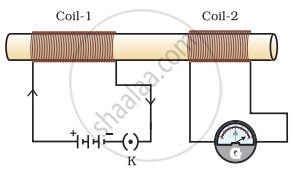
Also, connect the other coil-2 with a galvanometer as shown in the figure. Plugin the key. Observe the galvanometer. We will observe that the needle of the galvanometer instantly jumps to one side and just as quickly returns to zero, indicating a momentary current in coil-2.
Disconnect coil-1 from the battery. You will observe that the needle momentarily moves but to the opposite side. It means that now the current flows in the opposite direction in coil-2.
This shows that a current is set up in a closed loop when an external magnetic field passing through the loop increases or decreases.
APPEARS IN
संबंधित प्रश्न
Draw a labelled diagram showing the three magnetic field lines of a loop carrying current. Mark the direction of current and the direction of magnetic field by arrows in your diagram.
A wire, bent into a circle, carries current in an anticlockwise direction. What polarity does this face of the coil exhibit?
What is the direction of magnetic field at the centre of a coil carrying current in clockwise ?
Compare the magnetic field produced by a solenoid with the magnetic field of a bar magnet. Draw neat figures and name various components.
A magnet kept at the centre of two coils A and B is moved to and fro as shown in the diagram. The two galvanometers show deflection. State with a reason whether : x > y or x< y [x and y are magnitudes of deflection.]

Why is it that the magnetic field of a current-carrying coil having n turns, is ‘n’ times as large as that produced by a single turn (loop)?
State and illustrate the rule used for finding the polarity of the faces of a circular coil.
An induced emf is produced when a magnet is moved into a coil. The magnitude of induced emf does not depend on ____________.
If two circular coils can be arranged in any of the three situations as shown in the diagrams below, then their mutual induction will be:

The nature of magnetic field line passing through the centre of current carrying circular loop is ____________.
Why does a magnetic compass needle pointing North and South in the absence of a nearby magnet get deflected when a bar magnet or a current carrying loop is brought near it.
Explain with the help of a labelled diagram the distribution of magnetic field due to a current through a circular loop. Why is it that if a current carrying coil has n turns the field produced at any point is n times as large as that produced by a single turn?
The correct pattern of magnetic field lines of the field produced by a current carrying circular loop is:
