Advertisements
Advertisements
प्रश्न
Explain the peptide bond.
Explain the following term:
Peptide bond
स्पष्ट कीजिए
Advertisements
उत्तर
- The covalent bond that links the two amino acids is called a peptide bond.
- The peptide bond is formed by a condensation reaction.
- \[\ce{(-NH2)}\] of one amino acid and the carboxyl group \[\ce{(-COOH)}\] of another amino acid, resulting in the formation of a peptide linkage.
- This process can be repeated multiple times, forming longer peptide chains known as polypeptides or proteins.
shaalaa.com
Biomolecules in the Cell
क्या इस प्रश्न या उत्तर में कोई त्रुटि है?
संबंधित प्रश्न
Answer the following question.
Enlist the examples of simple protein and add their significance.
Answer the following question.
What is RNA? Enlist types of RNA.
Complete the following chart.
| Protein | Physiological role |
| Collagen | ___________ |
| __________ | Responsible for muscle contraction |
| Immunoglobulin IgG | ___________ |
| ___________ | Significant in respiration |
| Fibrinogen | ____________ |
Answer the following with reference to the following figure.
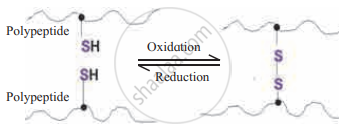
- Name the type of bond formed between two polypeptides.
- Which amino acid is involved in the formation of such bond?
- Amongst I, II, III and IV structural level of protein, which level of structure includes such bond?
Long answer question.
What are biomolecules?
Long answer question.
How are enzymes classified? Mention an example of each class.
Long answer question.
What is metabolism?
If double-stranded DNA has 14% C (cytosine) what percent A (adenine), T (thymine) and G (gaunine) would you expect?
Name the form in which carbohydrate is transported in a plant.
Name the reagent used for testing for reducing sugar.
