Advertisements
Advertisements
प्रश्न
Explain the law of demand.
State the law of demand and illustrate it with the help of a demand curve.
Explain the law of demand with the help of a diagram and schedule. Give two reasons why it slopes downwards to the right.
Explain critically the law of Demand.
Explain the law of demand with the help of assumptions, a diagram, and a schedule.
Advertisements
उत्तर
The law of demand was first stated by Augustin Cournot in 1838. Later it was refined and elaborated by Alfred Marshall.
Definition:
The law of demand says, “The quantity demanded increases with a fall in price and diminishes with a rise in price” – Marshall.
Assumptions of the law:
- The income, taste, habit, and preference of the consumer remain the same.
- No change in the prices of related goods.
- No substitutes for the commodity.
- The demand for the commodity must be continuous.
- No change in the quality of the commodity.
If there is a change even in one of these assumptions, the law will not operate.
Demand schedule:
| Price (Rs.) | Quantity Demanded |
| 5 | 1 |
| 4 | 2 |
| 3 | 3 |
| 2 | 4 |
| 1 | 5 |
From the above schedule, if the price of the good is 5, then the quantity demanded is 1 unit and if the price decreases to 1, the quantity demanded rises to 5, which shows the inverse relationship between price and quantity demanded.
Diagram:

Quantity Demanded (in units):
In the above diagram, the X-axis represents the quantity demanded and the Y-axis represents the price. DD is the demand curve that has a negative slope. It indicates that when the price falls, the demand expands; when the price rises, the demand contracts.
Market demand for a commodity:
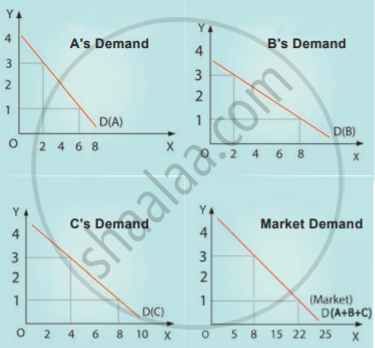
The market demand curve for a commodity is derived by adding the quantity demanded of all individuals in the market who demand the same quantity of the commodity.
Notes
Students should refer to the answer according to the question.
APPEARS IN
संबंधित प्रश्न
Briefly explain any two reasons for the occurrence of the law of demand.
Symbolically, the functional relationship between Demand and Price can be expressed as ______.
Find the odd word
Assumptions to law of demand -
The Law of Demand was introduced by ______.
State with reason whether you agree or disagree with the following statement.
There is an inverse relationship between price and demand.
Increase in demand is caused by
The movement on or along the given demand curve is known as ______
In case of relatively more elastic demand, the shape of the curve is
Distinguish between extension and contraction of demand.
Write a statement of the Law of Demand.
State with reason whether you agree or disagree with the following statement :
When price of Giffen goods fall, the demand for it increases.
The following table shows the demand schedule for 3 consumers in a market.
| Price in (Rs) | Consumer 1 Demand in (kgs) | Consumer 2 Demand in (kgs) | Consumer 3 Demand in (kgs) | Market Demand |
| 10 | 1 | 2 | (i) ______ | 6 |
| 8 | 2 | (ii) ______ | 4 | 9 |
| 6 | 3 | 4 | 5 | 12 |
| 4 | 4 | 5 | 6 | (iii) ______ |
Based on the above hypothetical schedule answer the following questions.
- What is the demand of Consumer 3 priced at Rs 10 (i)?
- What is the demand of Consumer 2 priced at Rs 8 (ii)?
- Calculate the total market demand priced at Rs 4 (iii).
- From the above given table examine the relationship between price and demand.
- Mention any one exception to the law of demand.
Any statement about demand for a good is considered complete only when the following is/are mentioned in it:
If with the rise in price of good Y, demand for good X rises, the two goods are:
When at a price of ₹ 5 per unit of a commodity, A’s demand is for 11 units, B’s demand is for 14 units and C’s demand is for 8 units (assuming that there are only three consumers in the market), the market demand is ______.
Giffen goods are richman's goods
If prices of cars rise, many people may put off buying a new car. So the demand for petrol will fall.
If a good is inferior good, then purchases of that good will decrease when ______.
Pick the option which does not belong to the group:
State the law of demand.
What is meant by the income effect of a fall in the prices of a commodity?
Explain four circumstances under which the law of demand does not operate.
Identify the correct statement from the following alternatives:
The following table shows the amount of sugar bought by a household at different prices:
| Period | Price (₹ per kg) | Amount Bought (kg) |
| Jan. 2000 | ₹ 15 | 4 |
| Feb. 2000 | ₹ 16 | 5 |
Does the behaviour of household contradict the law of demand? Give reasons in support of your answer.
State whether the following statement is true or false. Give reasons.
The law of demand states a direct relationship between price and demand.
What does the term "ceteris paribus" mean in relation to the Law of Demand?
According to the Law of Demand, what happens when the price of a commodity decreases, assuming no other factors change?
Which formula correctly expresses the factors that determine the demand for a commodity?
Which of the following is NOT an assumption of the Law of Demand ?
Why does the demand curve always slope downwards?
