Advertisements
Advertisements
प्रश्न
Explain the following process with a suitable example in the given case:
Step-growth polymerisation
What is step growth polymerisation, and how does it take place? Illustrate with an example.
What do you understand by step growth polymers? Discuss the general mechanism involved in its synthesis. Give two examples of it.
Advertisements
उत्तर
The polymers formed through a series of stepwise condensation reactions involving bifunctional or polyfunctional monomers are called step-growth polymers, and the process is termed step-growth polymerisation.
The growth step of bifunctional or polyfunctional monomers undergoes polymerization, which entails their progressive condensation with or without the removal of smaller molecules. The process starts with the condensation of two monomer units, which form a dimer, and doesn't require an initiator. The resulting dimer then condenses with the third monomer molecule to create a trimer. The procedure is repeated until a polymer with a very high molecular mass is produced. The method is known as step growth polymerization, and the final polymer is called a step growth polymer since it entails the stepwise creation of a polymer. The mechanism of step-growth polymerisation can be illustrated by the following scheme involving monomers A and B.
\[\ce{\underset{Monomers}{A + B} ->[Condensation] \underset{Dimer}{A - B}}\]
\[\ce{A - B + A ->[Condensation] \underset{Trimer}{A - B - A}}\]

For example, nylon-66 is a step-growth polymer. It is formed by the step growth polymerisation of monomers hexamethylenediamine and adipic acid (both bifunctional) through the following series of condensation reactions.
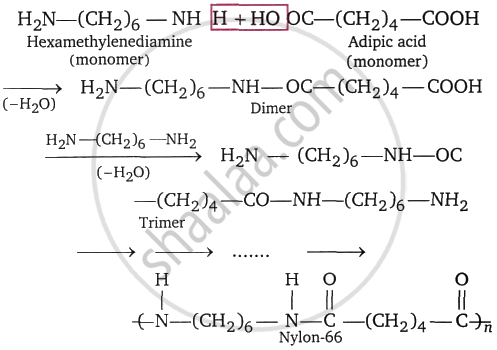
Since each step involves the elimination of a water (H2O) molecule, the repeating unit in nylon-66 is not the same as the monomers forming it.
