Advertisements
Advertisements
प्रश्न
Explain the characteristics of elastic and inelastic collision.
Advertisements
उत्तर
- In a collision, the total K.E of the bodies before the collision is equal to the total K.E. of the bodies after the collision, then it is an elastic collision.
Total K.E. before collision = Total K.E. after collision - Inelastic collision:
In a collision, the total K.E. of the bodies before the collision is not equal to the total K.E. after collision then it is called inelastic collision Even though K.E. is not conserved but total energy is conserved. After the collision of the two colliding bodies stick together such collision is called as perfectly inelastic a plastic collision.
APPEARS IN
संबंधित प्रश्न
The rate of change of total momentum of a many-particle system is proportional to the ______ on the system.
State if the following statement is true or false. Give a reason for your answer.
Total energy of a system is always conserved, no matter what internal and external forces on the body are present.
Answer carefully, with reason:
If the potential energy of two billiard balls depends only on the separation distance between their centres, is the collision elastic or inelastic? (Note, we are talking here of potential energy corresponding to the force during collision, not gravitational potential energy.)
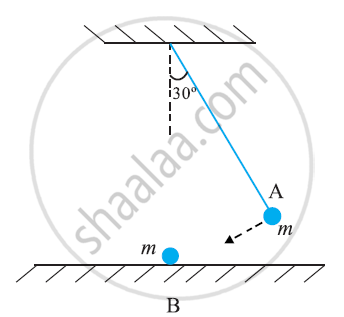
The bob A of a pendulum released from 30° to the vertical hits another bob B of the same mass at rest on a table, as shown in the figure. How high does the bob A rise after the collision? Neglect the size of the bobs and assume the collision to be elastic.
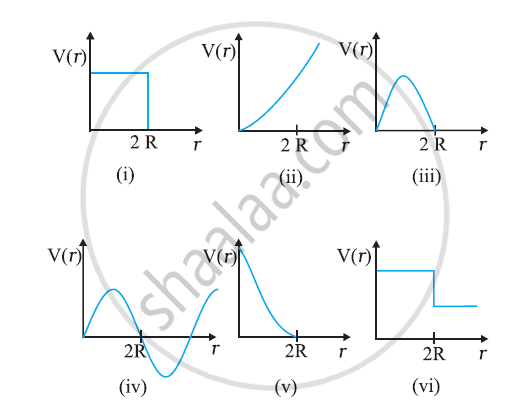
Which of the following potential energy curves in Fig. cannot possibly describe the elastic collision of two billiard balls? Here r is distance between centres of the balls.
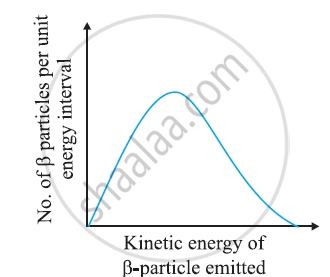
Consider the decay of a free neutron at rest : n → p + e–
Show that the two-body decay of this type must necessarily give an electron of fixed energy and, therefore, cannot account for the observed continuous energy distribution in the β-decay of a neutron or a nucleus
A block of mass 'm' moving along a straight line with constant velocity `3vec"v"` collides with another block of same mass at rest. They stick together and move with common velocity. The common velocity is ______.
A ball of mass m, moving with a speed 2v0, collides inelastically (e > 0) with an identical ball at rest. Show that for head-on collision, both the balls move forward.
A sphere of mass 'm' moving with velocity 'v' collides head-on another sphere of same mass which is at rest. The ratio of final velocity of second sphere to the initial velocity of the first sphere is ______. ( e is coefficient of restitution and collision is inelastic)
In a collision, what type of interaction occurs between objects?
