Advertisements
Advertisements
प्रश्न
Explain Reflection at curved surfaces.
Advertisements
उत्तर
- When the sound waves are reflected from the curved surfaces, the intensity of the reflected waves is changed.
- When reflected from a convex surface, the reflected waves are diverged out and the intensity is decreased.
- When sound is reflected from a concave surface, the reflected waves are converged and focused at a point. So the intensity of reflected waves is concentrated at a point.
- Parabolic surfaces are used when it is required to focus the sound at a particular point. Hence, many halls are designed with parabolic reflecting surfaces.
- In elliptical surfaces, sound from one focus will always be reflected the other focus, no matter where it strikes the wall.
APPEARS IN
संबंधित प्रश्न
How is the frequency of a stretched string related to its length?
A certain sound has a frequency of 256 hertz and a wavelength of 1.3 m.
1) Calculate the speed with which this sound travels
2) What difference would be felt by a listener between the above sound and another sound traveling at the same speed, but of wavelength 2.6 m?
Name the characteristic of sound in relation to its waveform.
Define amplitude term in relation to a wave.
The following diagram shows three ways in which the string of an instrument can vibrate.
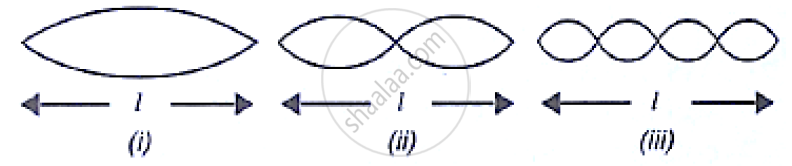
(a) which of the diagram shows the principal note?
(b) which has the frequency four times that of the first?
(c) what is the ratio of the frequency of the vibration in (i) and (ii)?
Name two sound absorbing materials (or objects) which can make our big room less echoey.
What is a bulb horn ? Name the principle on which a bulb horn works.
Explain how the principle of echo is used by
The dolphin to locate small fish as its prey
What are mechanical waves?
Write the approximate value of the speed of sound in iron.
How are bats able to fly in the dark?
State two factors on which the natural frequency of a body depends.
A type of electromagnetic wave has a wavelength of 50 Å. Name the wave and state one use of this type of wave.
Why is an echo not heard when the distance between the source of sound and reflection body is less than 10 m?
What is meant by an echo? Explain.
The direction of the incident sound, the direction of reflected sound, and the normal are in different Planes.
