Advertisements
Advertisements
प्रश्न
Explain the process of transcription in Eukaryotes.
Advertisements
उत्तर
Transcription is the process of formation of RNA molecules from DNA. During transcription, only a segment of DNA from only one of the strands participates. The strand with 3' → 5' polarity acts as a template for RNA and is called template strand. The complementary DNA strand is called a coding strand, which is a misnomer.
Transcription takes place in following three steps:
(1) Initiation
-
RNA polymerase binds with the promoter sequence to initiate the process of transcription.
- Association with initiation factors alters the specificity of RNA polymerase to initiate the transcription.

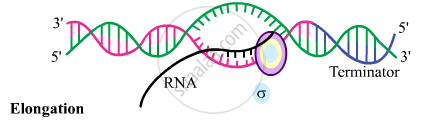
(2) Elongation
- RNA polymerase uses nucleoside triphosphate as substrate, and polymerisation occurs according to complementarity.
- Sigma subunit dissociates as the RNA polymerase enters elongation phase.
(3) Termination
-
Termination occurs when termination factor (rho protein) alters the specificity of RNA polymerase to terminate the transcription.
As the RNA polymerase proceeds to perform elongation, a short stretch of RNA remains bound to the enzyme. As the enzyme reaches the termination region, this nascent RNA falls off and transcription is terminated.
The precursor of mRNA, i.e. hnRNA, undergoes many changes before proceeding to translation. Since it contains both coding (exons) and non-coding regions (introns), it also undergoes splicing. These changes are collectively known as post-transcriptional modifications. These are as follows:
- Capping - In this, 7-methyl guanosine triphosphate is added to the 5' end of hnRNA.
-
Tailing - In this, adenylate residues are added to the 3' end of hnRNA by the enzyme poly (A) synthetase.
- Splicing - The hnRNA contains both introns and exons. Introns are removed and exons are joined by a process called splicing.

APPEARS IN
संबंधित प्रश्न
Methyl guanosine triphosphate is added at 5' end of hn-RNA in a process of ______.
If the base sequence of a codon in mRNA is 5'-AUG-3', the sequence of tRNA pairing with it must be ______.
Which is the “Only enzyme” that has “Capability” to catalyse Initiation, Elongation and Termination in the process of transcription in prokaryotes?
Identify the correct statement.
What are the functions of poly-A “tail” in a mature on RNA?
Give an account of post transcriptional modifications of a eukaryotic mRNA.
Which nitrogenous base in RNA pairs with adenine during bacterial transcription?
Which mechanism of transcription termination in bacteria does not require a protein factor?
Which single enzyme in bacteria synthesizes all types of RNA (mRNA, tRNA, and rRNA)?
Which DNA sequence element serves as the primary recognition site for the sigma factor in bacterial promoters?
