Advertisements
Advertisements
प्रश्न
Explain the principle of the method of electrolytic refining of metals. Give one example.
Outline the principles of refining of metals by the following methods: Electrolytic refining
Write the principle of electrolytic refining.
Advertisements
उत्तर १
Electrolytic refining:
Principle: In this method, an anode of a block of impure metal and a cathode of a thin sheet of pure metal, are suspended in an electrolyte solution which is the solution of a soluble salt of the metal usually a double salt of the metal. For example, the purest copper is obtained by an electrolytic refining method. A slab of impure copper as the anode and a thin sheet of pure copper as the cathode are dipped in the electrolyte which is an acidic solution of copper sulphate. On passing electricity through the cell, copper is dissolved from the anode and deposited on the cathode.
Anode: Cu(s) → Cu 2+ (aq) + 2e-
Cathode: Cu2+ (aq) +2e- → Cu (s)
The impurities of iron, nickel, zinc and cobalt present in blister copper being more electropositive pass into solution as soluble sulphates. The impurities of antimony, selenium, tellurium, silver, gold and platinum being less electropositive are not affected by CuSO4-H2SO4 solution. Therefore, these impurities get settle down under the anode as anode mud or anode sludge.
उत्तर २
Electrolytic refining - Electrolytic refining is the process of refining impure metals by using electricity. In this process, impure metal is made the anode and a strip of pure metal is made the cathode. A solution of a soluble salt of the same metal is taken as the electrolyte. When an electric current is passed, metal ions from the electrolyte are deposited at the cathode as pure metal and the impure metal from the anode dissolves into the electrolyte in the form of ions. The impurities present in the impure metal gets collected below the anode. This is known as anode mud.
Anode : `M -> M^(n+) + "ne"^-`
Cathode:` M^(n+) + "ne"^(-) -> M`
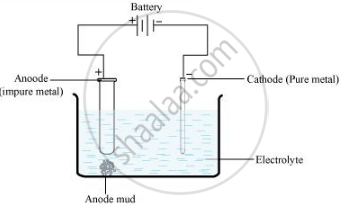
उत्तर ३
Electrolytic refining:
Electrolytic refining is the process of refining impure metals by using electricity. In this process, impure metal is made the anode and a strip of pure metal is made the cathode. A solution of a soluble salt of the same metal is taken as the electrolyte. When an electric current is passed, metal ions from the electrolyte are deposited at the cathode as pure metal and the impure metal from the anode dissolves into the electrolyte in the form of ions. The impurities present in the impure metal gets collected below the anode. This is known as anode mud.
Anode : `M -> M^(n+) + "ne"^-`
Cathode : `M^(n+) + "ne"^(-) -> M`
APPEARS IN
संबंधित प्रश्न
Name the method used for the refining of Nickel metal.
Name the method of refining of metals such as Germanium.
What criterion is followed for the selection of the stationary phase in chromatography?
Describe a method for refining nickel.
Outline the principles behind the refining of metals by the following methods:
Zone refining method
What happens when NaCN is added in an ore containing PbS and ZnS during concentration by froth floatation method?
Name the method of refining which is Used to obtain semiconductor of high purity.
Zone refining is based on the principle that ______.
In the extraction of chlorine from brine:
(i) ∆GΘ for the overall reaction is negative.
(ii) ∆GΘ for the overall reaction is positive.
(iii) EΘ for overall reaction has negative value.
(iv) EΘ for overall reaction has positive value.
Which method is used for refining Zr and Ti? Explain with equation.
How are metals used as semiconductors refined? What is the principle of the method used?
Assertion: Nickel can be purified by Mond process.
Reason: \[\ce{Ni(CO)4}\] is a volatile compound which decomposes at 460 K to give pure Ni.
Assertion: Zone refining method is very useful for producing semiconductors.
Reason: Semiconductors are of high purity.
Which one of the following methods can be used to obtain highly pure metal which is liquid at room temperature?
Describe a method for refining nickel.
Describe a method for refining nickel.
Describe a method for refining nickel.
Describe a method for refining nickel.
Describe a method for refining nickel.
