Advertisements
Advertisements
प्रश्न
Explain any three types of price elasticity of demand with the help of diagrams.
Discuss five cases of elasticity of demand.
Explain the different types of price elasticity of demand with the help of diagrams.
Explain various degrees of price elasticity of demand with diagrams.
स्पष्ट कीजिए
Advertisements
उत्तर १
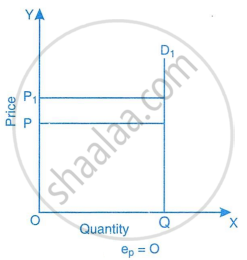
- Perfectly Inelastic Demand: When quantity demanded does not change at all as a result of change in price of the commodity, demand of that commodity is said to be perfectly inelastic. In such a case, quantity demanded is independent of price changes. Demand here is non-responsive and the numerical value of price elasticity (Ed) will be zero. Demand curve will be parallel to Y-axis as shown in Figure. In the figure, demand (OQ) is fixed. If price increases or decreases, it remains unchanged. This type of situation is normally not found in our real life.

- Unit Elastic Demand: In this situation, percentage change in demand is equal to percentage change in price. For instance, if price of milk rises by 20 per cent and consequently its demand also falls by 20 per cent, price elasticity of demand will be unitary elastic. According to Dr. Marshall, if elasticity of demand is equal to unity, total expenditure of the commodity remains the same even when the price changes. Cases of unitary elasticity are very rare.
Elasticity of demand will be unity when the demand curve takes the shape of rectangular hyperbola. Rectangular hyperbola is a curve under which all rectangular areas are equal. Each rectangular area shows the total expenditure (price x quantity) spent on the commodity at various prices.
- Perfectly Elastic Demand Curve: It is a situation in which a small change in price causes an infinitely large change in quantity demanded. A small rise in price on the part of the seller reduces the demand to zero. A small reduction in price, will increase the demand to infinity (i.e., no seller is able to satisfy this demand at the reduced price). In our real life, we do not have any such commodity which has perfectly elastic demand. Here, elasticity of demand is equal to infinity and demand curve becomes parallel to X-axis as shown in Figure. Alternatively speaking, here quantity demanded is independent of price. Price is given.
Demand for a good can be perfectly elastic only when there are some perfect substitutes of the good are available in the market. But perfect substitutes are not found in real life.
- Highly Elastic Demand: Highly elastic demand occurs when a proportionate change in price results in a greater than proportionate change in demand.

- Highly inelastic demand: Demand is very inelastic when a proportional change in price results in a less-than-proportional change in demand.

shaalaa.com
उत्तर २
- Perfectly Inelastic Demand: The elasticity of demand is 0 when the quantity of a good that is wanted does not change in response to a change in price. In this instance, regardless of changes in the commodity's price, the quantity demanded stays constant. The same amount is sought regardless of the price. This is an instance of demand that is perfectly inelastic. Perfectly or totally inelastic demand curves are those with zero elasticity. Figure is an illustration of this. Demand curve D1, a vertical straight line parallel to the Y-axis, is perfectly inelastic. Whether the price is OP or OP1, the quantity bought stays OQ. Even when it comes to basic requirements like food, there are relatively few instances of perfectly inelastic demand because price fluctuations can affect demand for these items. The demand for life-saving medications, on the other hand, is completely inelastic.
- Perfectly Elastic Demand: The price elasticity of demand for a commodity is said to be infinite when buyers are willing to pay a certain price for all they can get but nothing at a slightly higher price. In this instance, a very slight decrease in a commodity's price results in an infinite (∞) increase in demand. Perfectly or totally elastic demand curves are demand curves with infinite elasticity. Demand is perfectly elastic in this situation. Perfectly elastic demand is shown by the horizontal straight line demand curve D2 in Figure, which runs parallel to the X-axis. Nothing is demanded at price OP, but an indefinitely vast quantity is demanded at a little lower price OP. This represents price elasticity's upper limit or extreme. There are very few instances of demand that is perfectly elastic.

- Unitary Elastic Demand: The elasticity of demand is said to be unitary (or one) when a given percentage change in a commodity's price results in an equivalent percentage change in the amount requested. For instance, the elasticity of demand is equal to one if a ten percent decrease in the commodity's price results in a ten percent increase in the quantity bought. Figure displays a demand curve with unitary elasticity across its whole range. Unitary elasticity is present at every point on demand curve D3. A rectangular hyperbola curve is the name given to such a curve. A rectangular hyperbola curve, as used in mathematics, is a curve where the total area of the rectangles at various locations on the curve is equal. Such a circle uniformly extends towards the X and Y axes, yet it never makes contact with them. As a result, a rectangular hyperbola is the shape that the demand curve exhibiting unitary elasticity of demand on each of its points takes. Unitary elastic demand cases are quite uncommon.

- Elastic Demand: The elasticity of demand is higher than unitary when the percentage change in the amount requested of a good surpasses the percentage change in its price. In this case, demand elasticity is higher than unity. Here, demand is said to be rather elastic. Demand is said to be elastic, for instance, if a 10% drop in the commodity's price results in a 15% rise in the quantity required. The demand for luxury items is typically elastic. Because the percentage change in quantity demanded from OQ0 to OQ1 is comparatively greater than the percentage rise in price from OP0 to OP1, demand curve D4 in Fig. is elastic between A and B.

- Inelastic Demand: When the percentage change in a commodity's quantity sought is smaller than the percentage change in its price, the demand is said to be inelastic. Here, the demand elasticity is smaller than unity. We refer to this good's demand as being comparatively inelastic. Demand is inelastic, for example, if a ten percent drop in a commodity's price results in an eight percent rise in the quantity sought. Because the percentage change in quantity required from OQ2 to OQ3 is less than the percentage change in price from OP2 to OP3, demand curve D4 is inelastic between C and D. The demand for needs is typically not very elastic.
shaalaa.com
Notes
Students should refer to the answer according to their questions.
क्या इस प्रश्न या उत्तर में कोई त्रुटि है?
अध्याय 3: Elasticity of Demand - Exercise [पृष्ठ ९०]
