Advertisements
Advertisements
प्रश्न
Evaluate Sardar Patel’s role in the integration of princely states with Indian Union.
Advertisements
उत्तर
Sardar Patel, India's first Deputy Prime Minister and Home Minister, was instrumental in integrating the princely states into the Indian Union.
- At the time of independence, India had 565 princely kingdoms, and the British gave them the option of joining India or Pakistan or remaining independent. However, Sardar Patel recognized the importance of incorporating these kingdoms into India to build a mighty nation.
- Sardar Patel utilized diplomatic techniques to persuade the states to sign the Instrument of Accession, in which the princely states ceded their rights to the Government of India in defence, foreign affairs, and communication. The majority of princely nations accepted this and joined India.
- Some princely states, like Hyderabad, Junagadh, Jodhpur, Jammu, and Kashmir, wreaked havoc on the Indian administration. However, military intervention ensured that they also became a part of India.
- Sardar Patel believed in both diplomacy and physical might. He made every effort to ensure that the princely states joined India peacefully. His Secretary, V.P. Menon, was also instrumental in merging the princely states into the Union of India.
संबंधित प्रश्न
Here are two opinions :-
Bismay: “The merger with the Indian State was an extension of democracy to the people of the Princely States."
Inderpreet: “I am not so sure, there was force being used. Democracy comes by creating consensus.”
What is your opinion in the light of accession of Princely States and the responses of the people in these parts?
The First Home Minister of independent India was ____________.
The states created in 1960 were:
Which state was not created in 2000?
When Meghalaya was carved out of Assam?
Name the original state from which Chattisgarh was carved out.
Which one of the following is a princely state of India that initially resisted joining the Indian Union?
How many princely states existed at the time of independence of India?
The Nizam wanted an independent status for Hyderabad. He entered into what was called the standstill agreement with India in November 1947 for ______ while negotiations with the Indian Government were going on.
Sardar Vallabhbhai Patel was entrusted with the task of the unification of the princely states. Which of the following argument is not correct?
Indian Government had taken a firm stand to prevent possible division of the country into small principalities after independence. Consider the following statements in this regard-
- Government showed more rigidity towards giving autonomy to these princely states.
- Accession of princely states of Junagarh, Hyderabad, Kashmir, and Manipur ·proved more difficult than the rest
Choose the correct statement-
Hyderabad was the largest princely state when India got independence; Its accession proved to be a difficult task. Consider the following statements and find the correct statement/s:
- Some parts of the old Hyderabad state are today’s parts of Maharashtra, Karnataka, Andhra Pradesh, and Tamil Nadu.
- Nizam of Hyderabad entered into a Standstill Agreement with India in September 1947 for six months while negotiations were going on with the Indian Government.
Who played an important role in the integration of Princely States with India?
What do you understand by the ‘British paramountcy or suzerainty’?
Which one of the following leaders played an important role in the integration of the princely states with India?
Which princely state of India was the first to announce the remain as an independent state?
Which of the following states initially refused to join the Indian Union?
A paramilitary force of Nizam of Hyderabad which was sent to respond people's movement was known as ______.
The Maharaja of Manipur at the time of independence was ______.
What do you understand by the 'British paramountcy or suzerainty'?
Enlist the main considerations for bringing the Princely States with the Indian Union. Name the leader who played a historic role in this direction. What was his contribution?
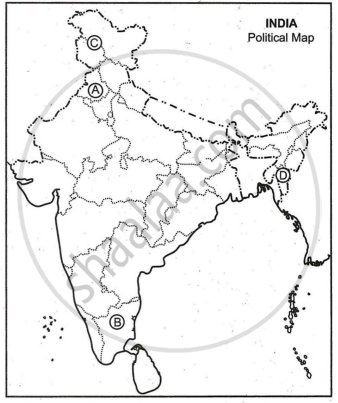
In the given political outline map of India, four states have been marked as (A), (B), (C) and (D). Identify these states on the basis of the information given below and write their correct names in your answer book along with the respective serial number of the information used and the concerned alphabets given in the ‘map as per the format that follows:
| S.No.of the information used |
Concerned Alphabet |
Name of the State |
| (i) | ||
| (ii) | ||
| (iii) | ||
| (iv) |
- The state which has been bifurcated in two Union Territories recently.
- The state where Rajiv Gandhi-Longowal Accord was signed.
- The state to which Laldenga belonged.
- The state from where the Dravidian Movement started.