Advertisements
Advertisements
प्रश्न
Each side of a square is 44 cm. Find its perimeter. If this perimeter is equal to the circumference of a circle, find the radius of the circle.
Advertisements
उत्तर
The side of a square = 44 cm
∴ Its perimeter = 4 × Side
= 4 × 44 = 176 cm
Since, Its is given that, Circumference of a circle = Perimeter of a square
∴ Circumference of a circle = 176 cm
Let, the radius of the circle = r
⇒ 2πr = 176 cm
r = `(176xx7)/(2xx22)` = 28 cm
∴ The radius of the circle = 28 cm
APPEARS IN
संबंधित प्रश्न
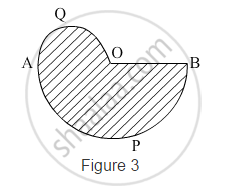
In Fig. 3, APB and AQO are semicircles, and AO = OB. If the perimeter of the figure is 40 cm, find the area of the shaded region [Use `pi=22/7`]
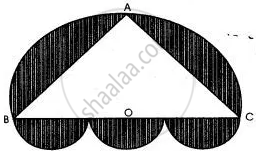
A doorway is decorated as shown in the figure. There are four semi-circles. BC, the diameter of the larger semi-circle is of length 84 cm. Centres of the three equal semicircles lie on BC. ABC is an isosceles triangle with AB = AC. If BO = OC, find the area of the shaded region. (Take `pi = 22/7`)
A road which is 7m wide surrounds a circular park whose circumference is 352m. Find the area of road.
Find the circumferences of a circle whose radius is 7 cm.
The circumference of a circle is 8 cm. Find the area of the sector whose central angle is 72°.
The radius of the wheel of a vehicle is 42 cm. How many revolutions will it complete in a 19.8-km-long journey?
In a circle of radius 21 cm, an arc subtends an angle of 60° at the centre. The length of the arc is ______.
Find the curved surface area , the total surface area and the volume of a cone if its :
Height = 15 cm , radius = 8 cm
The shaded portion of the figure, given alongside, shows two concentric circles. If the circumference of the two circles is 396 cm and 374 cm, find the area of the shaded portion.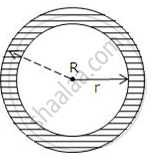
Find the radius of a circle whose circumference is equal to the sum of the circumferences of two circles of radii 15 cm and 18 cm.
