Advertisements
Advertisements
प्रश्न
Draw the diagram of a mature embryo sac and show its 8-nucleate, 7-celled nature. Show the following parts: antipodals, synergids, egg, central cell, polar nuclei.
Advertisements
उत्तर
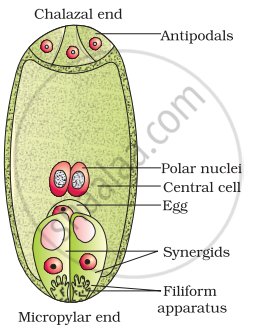
APPEARS IN
संबंधित प्रश्न
The embryo sac is ______
The method of embryo sac forming from a single megaspore is called ______.
In an embryo sac, the cells that degenerate after fertilisation are ______.
In a flower, if the megaspore mother cell forms megaspores without undergoing meiosis and if one of the megaspores develops into an embryo sac, its nuclei would be ______.
Name the component cells of the ‘egg apparatus’ in an embryo sac.
With a neat, labelled diagram, describe the parts of a mature angiosperm embryo sac. Mention the role of synergids.
Embryo sacs of some apomictic species appear normal but contain diploid cells. Suggest a suitable explanation for the condition.
Trace the development of a megaspore mother cell to the formation of a mature embryo sac in a flowering plant.
Draw a diagram of the mature embryo sac of an angiospermic ovule and label any four parts in it.
Which cells are located at the chalazal end of the mature embryo sac, and how many of them are present?
The central cell of the mature embryo sac contains two polar nuclei. What is the ploidy level of the central cell after the two polar nuclei fuse?
The mature embryo sac is described as monosporic and of the Polygonum type. What does the term monosporic indicate about the origin of the embryo sac?
Based on the cell distribution table, which cell or group of cells contributes a haploid gamete nucleus during double fertilization?
What is the total number of haploid nuclei present in the 8-nucleate stage of the developing female gametophyte before cell walls are formed?
In the mature embryo sac, which structure contains the filiform apparatus that aids in guiding the pollen tube?
