Advertisements
Advertisements
प्रश्न
Draw a ∆ABC in which base BC = 6 cm, AB = 5 cm and ∠ABC = 60°. Then construct another triangle whose sides are \[\frac{3}{4}\] of the corresponding sides of ∆ABC.
Advertisements
उत्तर
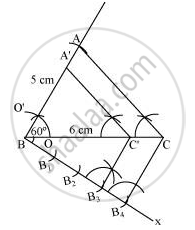
ΔA'BC' whose sides are `3/2`of the corresponding sides of ΔABC can be drawn as follows.
Step 1 Draw a ΔABC with side BC = 6 cm, AB = 5 cm and ∠ABC = 60°.
Step 2 Draw a ray BX making an acute angle with BC on the opposite side of vertex A.
Step 3 Locate 4 points (as 4 is greater in 3 and 4), B1, B2, B3, B4, on line segment BX.
Step 4 Join B4C and draw a line through B3, parallel to B4C intersecting BC at C'.
Step 5 Draw a line through C' parallel to AC intersecting AB at A'. ΔA'BC' is the required triangle.
Justification
The construction can be justified by proving
`A'B = 3/4 AB, BC' = 3/4 BC , A'C' = 3/4 AC`
In ΔA'BC' and ΔABC,
∠A'C'B = ∠ACB (Corresponding angles)
∠A'BC' = ∠ABC (Common)
∴ ΔA'BC' ∼ ΔABC (AA similarity criterion)
⇒ `(A'B)/(AB) = (BC')/(BC) = (A'C')/(AC) `… (1)
In ΔBB3C' and ΔBB4C,
∠B3BC' = ∠B4BC (Common)
∠BB3C' = ∠BB4C (Corresponding angles)
∴ ΔBB3C' ∼ ΔBB4C (AA similarity criterion)
⇒`(BC')/(BC) = (BB_3)/(BB_4)`
⇒`(BC') / (BC) = 3/4 ....... (2)`
From equations (1) and (2), we obtain
`(A'B)/(AB) = (BC')/(BC) = (A'C')/(AC) = 3/4`
⇒`A'B = 3/4 AB, BC' = 3/4 BC , A'C' = 3/4 AC`
