Advertisements
Advertisements
प्रश्न
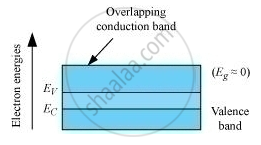
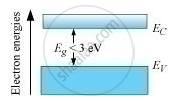
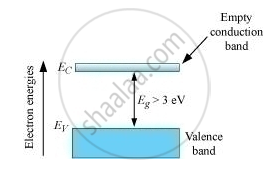
Distinguish between a conductor, a semiconductor and an insulator on the basis of energy band diagrams.
Advertisements
उत्तर
The energy-band diagram of a conductor is represented as
The energy-band diagram of a semiconductor is represented as
The energy-band diagram of an insulator is represented as
APPEARS IN
संबंधित प्रश्न
Distinguish between a metal and an insulator on the basis of energy band diagrams ?
We have valence electrons and conduction electrons in a semiconductor. Do we also have 'valence holes' and 'conduction holes'?
A p-type semiconductor is
The impurity atoms with which pure silicon may be doped to make it a p-type semiconductor are those of
(a) phosphorus
(b) boron
(c) antimony
(d) aluminium.
Calculate the number of states per cubic metre of sodium in 3s band. The density of sodium is 1013 kgm−3. How many of them are empty?
The band gap between the valence and the conduction bands in zinc oxide (ZnO) is 3.2 eV. Suppose an electron in the conduction band combines with a hole in the valence band and the excess energy is released in the form of electromagnetic radiation. Find the maximum wavelength that can be emitted in this process.
Two radioactive substances A and B have decay constants 3λ and λ respectively. At t = 0 they have the same number of nuclei. The ratio of the number of nuclei of A to those of B will be `1/"e"` after a time interval:
The energy of a hydrogen atom in the ground state is −13.6 eV. The energy of a He+ ion in the first excited state will be:
An n-type semiconductor is
In a common base configuration Ie = 1 mA α = 0.95 the value of base current is
