Advertisements
Advertisements
प्रश्न
Discuss conservation of angular momentum with example.
Advertisements
उत्तर
When no external torque acts on the body, the net angular momentum of a rotating rigid body remains constant. This is known as the law of conservation of angular momentum.
τ = `"dL"/"dt"`
If τ = 0 then, L = constant.
As the angular momentum is L = Iω, the conservation of angular momentum could further be written for initial and final situations as,
Iiωi = Iiωi (or) Iω = constant
The above equations say that if I increase ω will decrease and vice – versa to keep the angular momentum constant.
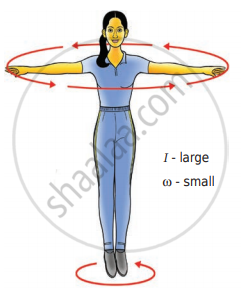
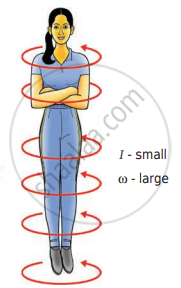
conservation of angular momentum for ice dancer
There are several situations where the principle of conservation of angular momentum is applicable. One striking example is an ice dancer as shown in Figure A. The dancer spins slowly when the hands are stretched out and spins faster when the hands are brought close to the body.
Stretching of hands away from body increases moment of inertia, thus the angular velocity decreases resulting in a slower spin. When the hands are brought close to the body, the moment of inertia decreases, and thus the angular velocity increases resulting in a faster spin. A diver while in the air as in Figure B curls the body close to decrease the moment of inertia, which in turn helps to increase the number of somersaults in the air.

conservation of angular momentum for a diver
APPEARS IN
संबंधित प्रश्न
Do we need a banked road for a two-wheeler? Explain.
On what factors does the frequency of a conical pendulum depend? Is it independent of some factors?
Somehow, an ant is stuck to the rim of a bicycle wheel of diameter 1 m. While the bicycle is on a central stand, the wheel is set into rotation and it attains the frequency of 2 rev/s in 10 seconds, with uniform angular acceleration. Calculate:
- The number of revolutions completed by the ant in these 10 seconds.
- Time is taken by it for first complete revolution and the last complete revolution.
Starting from rest, an object rolls down along an incline that rises by 3 in every 5 (along with it). The object gains a speed of `sqrt 10` m/s as it travels a distance of `5/3` m along the incline. What can be the possible shape/s of the object?
Derive an expression for maximum safety speed with which a vehicle should move along a curved horizontal road. State the significance of it.
A particle undergoes uniform circular motion. The angular momentum of the particle remains conserved about, ______
When a mass is rotating in a plane about a fixed point, its angular momentum is directed along, ______
What is the relation between torque and angular momentum?
A ring and a disc of different masses are rotating with the same kinetic energy. If we apply a retarding torque τ on the ring, it stops after completing n revolution in all. If the same torque is applied to the disc, how many revolutions would it complete in all before stopping?
What is the difference between rotation and revolution?
