Advertisements
Advertisements
प्रश्न
Differentiate between members of the following pairs with reference to the aspect asked within bracket:
Tricuspid and bicuspid values (location)
Advertisements
उत्तर
|
Tricuspid valve |
Bicuspid valve |
|
It is located between the right atrium and right ventricle of the heart. |
It is located between the left atrium and left ventricle of the heart. |
संबंधित प्रश्न
Why is blood needed by all the parts of a body?
Describe, in brief, the circulatory system in human beings.
What is the function of tonsils?
Given below is a highly schematic diagram of the human blood circulatory system.
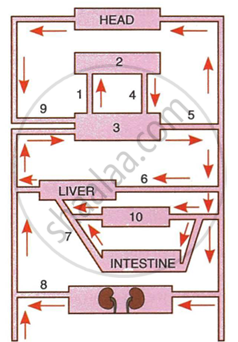 |
- Which part (state the number) represents the heart? Give reason in support of your answer.
- Which numbers represent the following, respectively?
Aorta Superior vena cava Hepatic portal vein Renal Vein Pulmonary artery Stomach
During surgical operations or during accidents, the patient may be given blood from outside to save his life. What is the technical name of this process? Briefly explain the precautions to be taken in this process.
The table below is designed to indicate the transport of certain substances in our body. Fill in the blanks with suitable answers.
| Substance | From | To | |
| 1. | ______ | Lungs | Whole Body |
| 2. | Carbon Dioxide | ______ | ______ |
| 3. | Urea | ______ | ______ |
| 4. | Digested Carbohydrates | Intestines | ______ |
| 5. | ______ | ______ | Target Organs |
| 6. | Heat | ______ | Whole Body |
Given below is a schematic representation of the circulatory system in man. Study the same and answer the questions that follow:
(i) Label the parts 1 to 4 indicated in the diagram.
(ii) Give one difference between parts 1 and 2 based on:
(a) their structure
(b) the nature of blood flowing through them.
(iii) What is the specific name of the type of blood circulation that takes place between the heart and the lungs?
(iv) Name the valve found at the beginning of the part labeled 3.
Complete the following sentence with appropriate word:
The foundations of physiology were laid by the physician __________.
Blood is produced in the bone marrow.
All the waste products of the body are excreted through the circulatory system.
