Advertisements
Advertisements
प्रश्न
Differentiate between members of the following pair with reference to what is asked in bracket.
Dynamic balance and static balance (Definition)
Advertisements
उत्तर
Dynamic balance is when the body is in motion whereas static balance is positional balance with respect to gravity.
संबंधित प्रश्न
Deafness is causal due to the rupturing of the Pinna.
Given below is a representation of a kind of pollution. Study the same and answer the questions that follow

(i) Name the kind of pollution.
(ii) List any three common sources of this pollution.
(iii) Mention three harmful effects of this pollution on human health.
(iv) Explain the term ‘Pollutant’.
(v) Name two soil pollutants
State the exact location of the Ciliary body
Given in the box below are a set of 14 biological terms. Of these, 12 can be paired into 6 matching pairs. Out of the six pairs, one has been done for you as an example.
Example : endosmosis - Turgid cell.
Identify the remaining five matching pairs :
| Cushing’s syndrome, Turgid cell, Iris, Free of rod and cone cells, Colour of eyes, Hypoglycemia, Active transport, Acrosome, Addison’s disease, Blind spot, Hyperglycemia, Spermatozoa, Endosmosis, Clotting of blood. |
Name that part of ear which vibrates when outside sound falls on it.
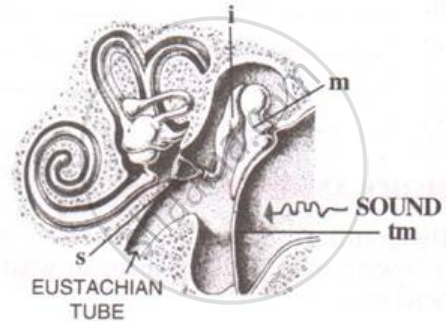
The figure below is the sectional view of a part of the skull showing a sense organ:

Name the part labeled 'tm'. What is its function?
Mention, if the following statement is True or False
The part of ear associated with balance is the cochlea.
With reference to human ear answer the question that follow:
Name the part of the ear associated with dynamic balance.
Given below is the diagram of a part of the human ear. Study the same and answer the questions that follow:
![]() |
- Give the collective biological term for Malleus, locus and Stapes.
- Name the parts labelled A, B and C in the diagram.
- State the functions of the parts labelled 'A' and 'B'.
- Name the audio receptor region present in the part labelled 'A'.
The figure given below shows the principal parts of a human ear. Study the diagram and answer the following questions.
![]() |
- Label the parts 1 to 8.
- State the role of parts 6, 7 and 8.
- Why is it harmful to use a sharp object to remove ear wax? Mention the number and name of the part involved.