Advertisements
Advertisements
प्रश्न
Differentiate between the luminous and non-luminous bodies. Give two examples of each.
Advertisements
उत्तर
Luminous
The bodies which have the light of their own e.g. sun stars, bulb, candle, oil lamp, torch, a lantern.
Non-Luminous
The bodies-which do not have their own Light. e.g. moon, chair, table. When light falls on them, they become visible.
APPEARS IN
संबंधित प्रश्न
Match the following
| (a). A light ray passes from air to glass | (1) . speeds up |
| (b). A light ray passes from glass to water | (2). reflects red light |
| (c). Virtual image | (3). primary colours |
| (d). Red rose | (4). plane mirror |
| (e). Red, green, and blue | (5). slows down |
How do we see objects around us ?
Fill in the blank.
A medium which allows light to pass through it easily is called the ...................
Fill in the blank.
Light travels in a ................. path.
Is the moon a luminous object?
What do we call a body that shines on its own?
Write true or false
The moon has its own light.
Sunlight is a blend of______ colors
What happens to light when it gets dispersed? Give an example.
Look at the figure given in the following figure.
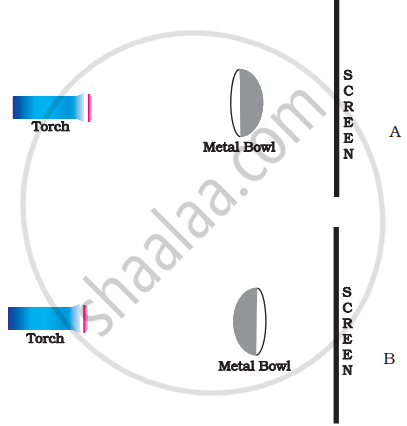
Will there be any difference in the shadow formed on the screen in A and B.
