Advertisements
Advertisements
प्रश्न
Diagrammatically, show the difference between the three types of muscle fibres.
Advertisements
उत्तर
- Striated muscles: These muscles are long and without branches. We can move these muscles as per our wishes, or we can stop their movement. These muscles are usually present in our hands and legs. They are directly connected to the skeleton.

- Unlined muscles: These muscles are long but their ends are pointed. Unlined muscles control those activities which we cannot control ourselves. These muscles are found in our eyelids, ureters, etc. These are found in the walls of our internal organs.
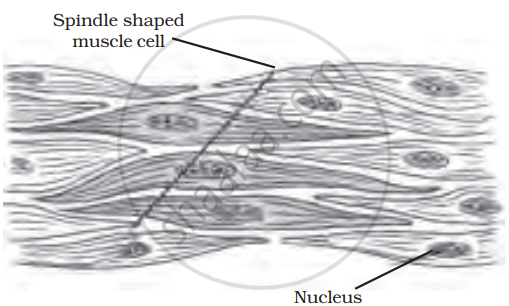
- Cardiac muscles: Cardiac muscles are small and flat-ended. They keep expanding and contracting throughout life. They are also called involuntary muscles. They are found in our heart and are found in the walls of the heart.

संबंधित प्रश्न
Give three features of cardiac muscles.
Write true or false of the statement. Rewrite the false statement correctly.
Voluntary muscles are present in the internal organs of the body.
Distinguish between the following pair in one or two sentences for striated and unstriated muscles.
Name the three kinds of muscles found in the human body. In each case, name one region in the body where they are found.
Differentiate between cells of:
Fibres of voluntary muscle and cardiac muscle.
Voluntary muscles are found in
Match the column (A) with the column (B)
| (A) | (B) | ||
| (a) | Fluid connective tissue | (i) | Subcutaneous layer |
| (b) | Filling of space inside the organs | (ii) | Cartilage |
| (c) | Striated muscle | (iii) | Skeletal muscle |
| (d) | Adipose tissue | (iv) | Areolar tissue |
| (e) | Surface of joints | (v) | Blood |
| (f) | Stratified squamous epithelium | (vi) | Skin |
Differentiate the following activities on the basis of voluntary (V) or involuntary (IV) muscles.
Writing with hand
What type of muscle tissue is found in the wall of internal organs?
A muscle fibre tapers at both ends and does not show striations. Name the muscle fibre.
