Advertisements
Advertisements
प्रश्न
Diagram alongside shows an equilateral prism and a ray PQ, incident on the face AB. Copy the diagram and on it show
- refracted ray
- emergent ray
- angle of incidence
- angle of refraction face AB
- angle of emergence
- angle of deviation
- Relation between angle of incidence, angle of emergence, angle of prism and angle of deviation.
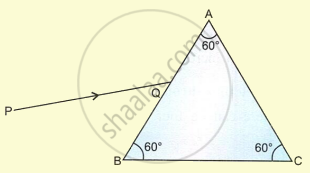
आकृति
Advertisements
उत्तर
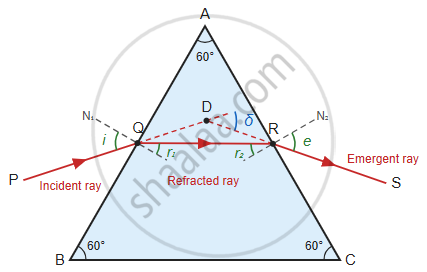
- Refracted ray: QR, bends towards the normal N1 inside the prism.
- Emergent ray: RS, bends away from the normal N2 on leaving face AC.
- Angle of incidence: i, between PQ and normal N1.
- Angle of refraction at face AB: r1, between QR and normal N1.
- Angle of emergence: e, between RS and normal N2.
- Angle of deviation: δ, at D, between the incident ray PQ extended forward and the emergent ray RS extended backward. These dashed extensions meet at D.
- Relation: \[ i + e = A + \delta \]
shaalaa.com
क्या इस प्रश्न या उत्तर में कोई त्रुटि है?
