Advertisements
Advertisements
प्रश्न
Diagram alongside shows a lead cube containing radioactive substance ‘R’. A magnetic field is applied, perpendicular to the path of nuclear radiation by a powerful horse-shoe magnet, P and Q beings its poles. The nuclear radiations split into three distinct parts X, Y and Z.
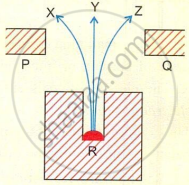
(a) (i) Identify X and state its mass and charge.
(ii) Identify Y and state its nature.
(iii) Identify Z and state its mass and charge.
(b) Identify the magnetic polarity of (i) P and (ii) Q.
(c) Which law helped you to find the polarity of the magnet? State the law.
Advertisements
उत्तर
(a) (i) X: α-particle
Mass: 4 amu (or mass number = 4)
Charge: +2e
(ii) Y: γ-radiation
Nature: Neutral electromagnetic waves
(iii) Z: β-particle
Mass: Negligible (\[\frac{1}{1837}\] of a proton)
Charge: −1e
(b)
(i) Pole P: South pole (S)
(ii) Pole Q: North pole (N)
(c) Law: Fleming's left-hand rule
Statement: Stretch the thumb, forefinger, and middle finger of the left hand mutually perpendicular to each other. If the forefinger points in the direction of the magnetic field and the middle finger points in the direction of the current, then the thumb points in the direction of the force (deflection).
Notes
In Goyal Brothers Prakashan, there is a typographical error in the textbook question (b). Radiations like X and Y have electric charge, not magnetic polarity. The question should ask for the magnetic polarity of the magnet poles P and Q instead of X and Y.
