Advertisements
Advertisements
प्रश्न
Describe the structure of an antibody.
Advertisements
उत्तर
Structure of antibody

Antibodies are glycoproteins that are highly specific to specific antigens.
Antibodies are also known as Immunoglobulins (Igs), produced in response to antigenic stimulation.
Antibodies are produced by plasma cells which in turn are formed by B–lymphocytes.
The mature plasma cells produce antibodies at an extremely rapid rate i.e. about 2000 molecules per second.
Structure of antibody:
- The antibody is a ‘Y’ shaped molecule.
- Each immunoglobulin molecule is made up of four polypeptide chains.
- There are two heavy or H-chains and two light or L-chains.
- The four polypeptide chains are held together by disulfide bonds (-s s-) to form a ‘Y’ shaped structure.
- The region holding together the arms and stem of the antibody is termed the hinge.
- Each chain of the antibody includes two distinct regions, the variable region, and the constant region.
- Variable regions constitute the antigen-binding site (paratope).
- This part of the antibody recognizes and binds to the specific antigen to form an antigen-antibody complex.
- Since most antibodies carry two antigen-binding sites, they are said to be bivalent.
APPEARS IN
संबंधित प्रश्न
The genotype of human blood group B is ______.
Genotype of human blood group ‘O’ will be ______.
Differentiate between antigen and antibody.
What are Non-communicable diseases?
Antigens generally bind to which site in the antibody molecule?
Which of the following is TRUE for a person with 'O' blood group?
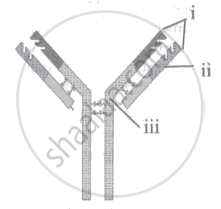
In the given figure of an antibody molecule, identify the labels (i, ii, and iii).
Which of the following is TRUE for individuals having 'A' blood group?
In an antibody molecule, the antigen-binding site is present on ____________.
In an antibody, disulphide bonds are present ______.
- between two heavy chains.
- between two heavy chains.
- between the constant region of light chain and the constant region of a heavy chain.
- between antigen binding sites of both the heavy and light chains.
- between the variable region of light chain and that of heavy chain.
Select the correct answer from the options given below
