Advertisements
Advertisements
प्रश्न
Describe the processes involved in the water cycle.
Advertisements
उत्तर
The water cycle or hydrological cycle is the continuous movement of water on earth. In this process, water moves from one reservoir to another, from the river to ocean or from ocean to the atmosphere by processes such as evaporation, sublimation, transpiration, condensation, precipitation, surface runoff, and infiltration, during which water converts itself to various forms like liquid, solid and vapour.
- Evaporation: Water evaporates from the surface of the earth and water bodies such as the oceans, seas, lakes, ponds and rivers turn into water vapour.
- Sublimation: Ice sheets and ice caps from the north and south poles, and icecaps on mountains get converted into water vapour directly, without converting into liquid.
- Transpiration: Transpiration is the process by which plants release water vapour to the atmosphere through small pores in leaves and stems.
- Condensation: At higher altitudes, the temperature is low. The water vapour present there condenses to form very tiny particles of water droplets. These particles come close together to form clouds and fog.
- Precipitation: Due to change in wind or temperature, clouds combine to make bigger droplets, and pour down as precipitation(rain). Precipitation includes drizzle, rain, snow and hail.
- Runoff: As the water pours down, it runs over the surface of the earth. Runoff water combines to form channels, rivers, lakes and ends up into seas and oceans.
- Infiltration: Some of the precipitated water moves deep into the soil. Then it moves down and increases the groundwater level.
- Percolation: Some of the precipitated water flows through soil and porous or fractured rock. Infiltration and percolation are two related but different processes describing the movement of water through the soil.
APPEARS IN
संबंधित प्रश्न
Make sketch of hydrological cycle in nature.
Why does the water split on the floor disappear after some time?
Choose the correct answer.
In the water cycle _____
Name the processes involved in the water cycle.
Observe the given graph carefully and answer the questions.
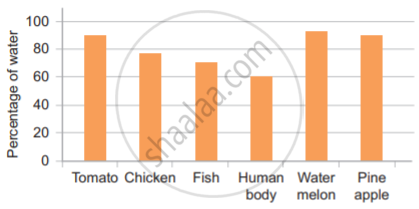
- What percentage of water is seen in fish?
- Name the food item that has maximum amount of water in its content.
- Name the food item that has minimum amount of water in its content.
- Human body consists of about ______ percentage of water.
- Specify the food item that can be consumed by a person when he/she is suffering from dehydration.
The ice sheets from the north and south poles and the icecaps on the mountains, get converted into water vapour through the process of ______.
Water kept in sunlight gets heat from sun and is evaporated. But how does water kept under the shade of a tree also gets evaporated? Explain.
The process of the water cycle that is related to the plants is called ______.
The wastes removed in tertiary treatment are ______.
______ is the reverse of vaporization.
