Advertisements
Advertisements
प्रश्न
Describe hormonal control in various phases of the menstrual cycle.
Describe menstrual cycle in human female.
Advertisements
उत्तर
- Menstrual phase: Day 1st - 5th day.
The endometrium of the uterus breaks down under the effect of prostaglandins released due to decreased levels of progesterone and estrogen. - Proliferative phase/Follicular phase/Post menstrual phase: Day 6th - 13th day.
A few secondary follicles proceed to develop but usually one of them develops into a Graafian follicle (mature follicle). The other secondary follicles degenerate. This process of degeneration is called atresia.
Developing secondary follicles secrete the hormone estrogen. The stimulation for the proliferation of new follicles is influenced by GnRH which stimulates the release of FSH. - Ovulatory phase: It is the shortest phase of the menstrual cycle. It involves rupturing of the mature Graafian follicle and the release of an ovum (secondary oocyte) into the pelvic cavity; usually on the 14th day of the menstrual cycle. Rapid secretion of LH by a positive feedback mechanism causes the mature follicle to rupture.
- Secretory phase/Luteal phase: Day 15th to 28th day.
After the release of the secondary oocyte, the remaining tissue of the Graafian follicle transforms into corpus luteum under the effect of LH. The Corpus luteum begins to secrete progesterone and estrogens. The ovulated egg may get fertilized within 24 hours. However, in the absence of fertilization, the corpus luteum can survive for only two weeks and then degenerate into a white scar called corpus Albicans.
The corpus luteum releases progesterone, a small amount of estrogens and inhibin. Under the influence of these hormones, the endometrial glands grow, become coiled and start uterine secretions. The endometrium becomes more vascularized and thickens up to 8-10 mm. Inhibin stops the secretion of FSH.
APPEARS IN
संबंधित प्रश्न
Observe the figure and answer the questions given below.
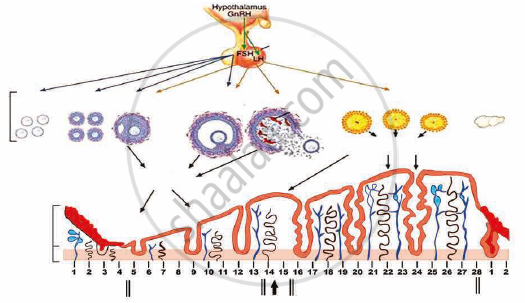
a) What does the above figure indicate?
b) Which human organs are involved in this process?
c) Name the hormones responsible for this process.
d) After how many days these repetitive changes take place?
e) ‚A woman should stay away from others, as her body is impure during this process.‛ What is your opinion about this statement? Elaborate it.
Write the answers to the following questions by observing the figure below.

- What does the figure above show?
- Which organs are involved in this process?
- Which hormones are involved in this process?
- After how many days do these changes happen again?
- Explain your opinion about the statement that a woman's body is impure while the above process is going on.
The luteal phase of the menstrual cycle is also called the secretory phase. Give reason.
Answer the following type of question Assertion (A) and Reason (R).
(A) - Ovulation is the release of the ovum from the Graafian follicle.
(R) - It occurs during the follicular phase of the menstrual cycle.
The following is the illustration of the sequence of ovarian events (a-i) in a human female.
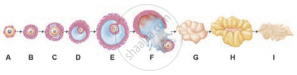
Explain the changes that occur in the uterus simultaneously in anticipation.
In the absence of fertilization, corpus luteum ____________.
In the human female, menstruation can be deferred by the administration of ______.
Proliferative phase of menstrual cycle, is also called ______.
A biology student after studying the different levels of hormones during the menstrual cycle was comparing 2 subjects (Patients). A table was created after looking at the levels of hormones A and B for Subjects 1 and 2. Read the information in the table and answer the question that follows.
| HORMONE A | HORMONE B | |
| Subject 1 | Shows a peak on the 14th Day of the menstrual cycle. | Falls down during the luteal phase. |
| Subject 2 | Shows a peak on the 14th Day of the menstrual cycle. | The level is maintained high in the luteal phase. |
Which of the following statements is true about the subjects?
Name these:
4 phases of the menstrual cycle.
