Advertisements
Advertisements
प्रश्न
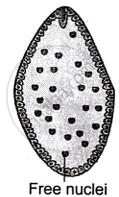
Describe the formation of helobial endosperm
Advertisements
उत्तर
Helobial type of endosperm:
a. It is an intermediate between nuclear and cellular type of endosperm.
b. First division of primary endosperm nucleus is followed by (division of cytoplasm) wall formation.
c. The wall formation results in the central cell being divided into a large micropylar and a small chalazal chamber.
d. In both the chambers the development occurs as seen in nuclear type.
e. This type is generally seen in Helobiae series of monocots, hence the name ‘Helobial Endosperm’.
APPEARS IN
संबंधित प्रश्न
Angiosperms bearing unisexual flowers are said to be either monoecious or dioecious. Explain with the help of one example each.
Why does endosperm development precede embryo development in angiosperm seeds?
______ is the first cell of female gametophytic generation in angiosperms.
In which of the following the primary endosperm nucleus undergoes free nuclear division or karyokinesis?
Identify the ploidy of embryo and endosperm respectively formed after following cross.
An angiospermic male plant with 24 chromosomes in its pollen mother cells is crossed with female plant bearing 24 chromosomes in its root cells.
Indentify the wrong statement regarding post-fertilisation development.
Coconut water contains:
The type of evolution where the central part is occupied by free nuclear and the peripheral part by cells is observed in ______.
The diagram given below shows the three types of endosperms in angiosperms.
 |
 |
 |
| Type 1 | Type 2 | Type 3 |
- Identify the three types of endosperms shown above.
- Name the type of endosperm which commonly occurs in polypetalous dicots.
During the process of nuclear type endosperm formation, what causes the free nuclei to be pushed to the periphery of the embryo sac?
