Advertisements
Advertisements
प्रश्न
Describe Fizeau’s method to determine the speed of light.
Advertisements
उत्तर

Speed of light by Fizeau’s method
Apparatus:
- The light from a source S was first allowed to fall on a partially silvered glass plate G kept at an angle of 45°
- It is then allowed to fall on a rotating tooth wheel with N teeth and N cuts of equal widths.
- Light passing through one cut will be reflected by a mirror M kept at a long distanced (about 8 km)
- If the wheel is not rotating, it gets reflected by a partially silvered glass plate.
Working:
- Angular speed of rotation of wheel was increased from zero to GO Until it blocked by an adjacent tooth.
- It is ensured by the disappearance of light while looking partially silvered glass plate.
Expression:
v = `"2d"/"t"`
where, d = distance, t = time taken
angular speed ω = `theta/"t"`
`theta = (2pi)/(2"N") = pi/"N"`
t = `pi/("N"omega)`
v = `(2"dN"omega)/pi = 2.9972 xx 10^8 "ms"^-1`
APPEARS IN
संबंधित प्रश्न
In Fizeau method of measuring the speed of light, the toothed wheel is placed in the focal plane of a converging lens. How would the experiment be affected if the wheel is slightly away from the focal plane?
In the original Fizeau method, the light travelled 8.6 km and then returned. What could be the difficulty if this distance is taken as 8.6 m?
What is the advantage of using a polygonal mirror with larger number of faces in Michelson method of measuring the speed of light?
The speed of light is 299, 792, 458 ms−1
(a) with respect to the earth
(b) with respect to the sun
(c) with respect to a train moving on the earth
(d) with respect to a spaceship going in outer space.
In an experiment with Foucault's apparatus, the various distances used are as follows:
Distance between the rotating and the fixed mirror = 16 m
Distance between the lens and the rotating mirror = 6 m,
Distance between the source and the lens = 2 m.
When the mirror is rotated at a speed of 356 revolutions per second, the image shifts by 0.7 mm. Calculate the speed of light from these data.
When a biconvex lens of glass having refractive index 1.47 is dipped in a liquid, it acts as a plane sheet of glass. This implies that the liquid must have refractive index.
A beam of light consisting of red, green and blue is incident on a right-angled prism as shown in figure. The refractive index of the material of the prism for the above red, green and blue colours are 1.39, 1.44 and 1.47 respectively. What are the colours suffer total internal reflection?
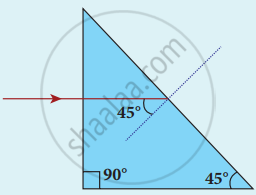
| A ray of light travels from a denser to a rarer medium. After refraction, it bends away from the normal. When we keep increasing the angle of incidence, the angle of refraction also increases till the refracted ray grazes along the interface of two media. The angle of incidence for which it happens is called critical angle. If the angle of incidence is increased further the ray will not emerge and it will be reflected back in the denser medium. This phenomenon is called total internal reflection of light. |
The critical angle for a pair of two media A and B of refractive indices 2.0 and 1.0 respectively is:
| A ray of light travels from a denser to a rarer medium. After refraction, it bends away from the normal. When we keep increasing the angle of incidence, the angle of refraction also increases till the refracted ray grazes along the interface of two media. The angle of incidence for which it happens is called critical angle. If the angle of incidence is increased further the ray will not emerge and it will be reflected back in the denser medium. This phenomenon is called total internal reflection of light. |
A point source of light is placed at the bottom of a tank filled with water, of refractive index µ, to a depth d. The area of the surface of water through which light from the source can emerge is:
A ray of light travels a distance of 12.0 m in a transparent sheet in 60 ns. The refractive index of the sheet is ______.
