Advertisements
Advertisements
प्रश्न
Describe an experiment to verify the laws of reflection of light. Ans. Laws of reflection.
Advertisements
उत्तर
(i) The incident ray, the reflected ray and the normal at the point of incidence, lie in the same plane.
(ii) The angle of incidence and angle of reflection are equal i.e. ∠i = ∠r.
Verification
Take a wooden drawing board and fix a white sheet of paper on it. In the middle of paper draw a straight line KK\ Mark a point B on it. Draw a perpendicular BN. Place a mirror XX’ on line KK’ such that polished side of mirror is along the line. Hold-the mirror in the mirror holder.
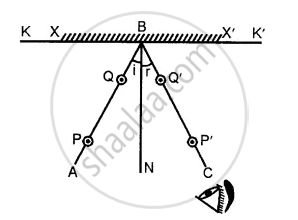
Fix two steel pins P and Q on the straight line AB atleast 10 cm apart. Look for the images of the pins P and Q and fix two pins P Q’ such that P’, Q’ and images of P and Q are all in the same straight line. Remove the pins and draw small circles around the pin pricks.
Remove the mirror also. Join P’Q’ and produce the straight line to meet at B.
Measure ∠ABN = i and ∠CBN = r.
It is found that ∠i = ∠r. This proves that Angle of Incidence is equal to Angle of Reflection.
As the incident ray, the reflected ray and the normal lie in the plane of paper, therefore, they lie in the same plane.
APPEARS IN
संबंधित प्रश्न
State the laws of reflection.
Describe an activity to show that the incident ray, the reflected ray and the normal at the point of incidence lie in the same plane.
A person 1 m in front of a plane mirror seems to be ______ m away from his image.
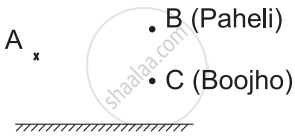
- Find out the position of the image of an object situated at A in the plane mirror.
- Can Paheli at B see this image?
- Can Boojho at C see this image?
- When Paheli moves from B to C, where does the image of A move?
State the two laws of reflection of light.
According to the law of reflection :
With the help of a diagram, state the laws of reflection
The laws of reflection hold good for
The incident ray, the ______ ray, and the ______ at the point of incidence, all lie in the same plane.
Which of the following is a non-mechanical wave?
