Advertisements
Advertisements
प्रश्न
Describe an experiment to prove the following:
HCI is highly soluble in water.
Advertisements
उत्तर
The high solubility of HCI gas can be demonstrated by "Fountain experiment''. In it, a well dried round bottom flask is filled with dry HCI gas and fitted with a two holed rubber stopper. A jet tube is inserted into the flask through one of the holes. A dropper filled with water is fitted into the other hole. Closing the outer end of the jet tube, the flask is inverted and the tube is dipped into a blue litmus solution taken in a beaker, then dropper is pressed. It is seen that the blue litmus solution enters the jet tube with a great force, forming a red fountain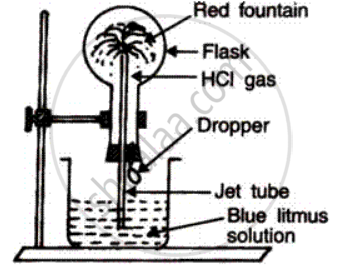
It happens because water introduced from dropper completely absorbs HCI gas, thereby creating a very low pressure within the flask. To make up for this loss in pressure, blue litmus solution rises in the jet tube and colour of litmus changes to red.
APPEARS IN
संबंधित प्रश्न
How will you prepare hydrochloric acid in laboratory?
Explain, why (or give reasons for)
Hydrochloric acid cannot be concentrated above 22.2% by boiling.
How can you prove that hydrochloric acid contain :
Hydrogen
Fill in the blank:
___________ agent converts hydrochloric acid to chlorine.
Write equation for the reaction between hydrochloric acid of the following: Manganese dioxide
Write equation for the reaction between hydrochloric acid of the following: Oxide of lead
Correct the following statement:
Hydrochloric acid is prepared in the laboratory by passing hydrogen chloride directly through water.
Aqua regia is a mixture of ______.
State one appropriate observation of the following:
Action of dilute HCl or sodium sulphite.
State your observation when :
Dilute hydrochloric acid is added to copper carbonate.
