Advertisements
Advertisements
प्रश्न
Describe an experiment to demonstrate that air exerts pressure.
Advertisements
उत्तर
Experiment to demonstrate that air exerts pressure:
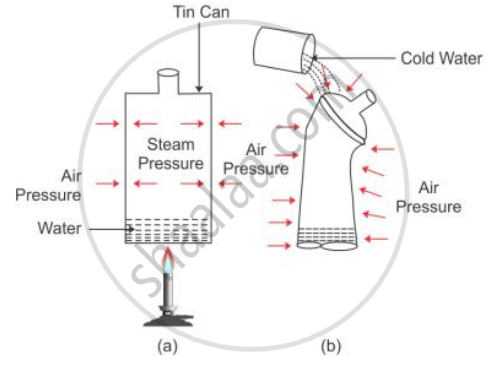
Take a thin can fitted with an airtight stopper. The stopper is removed and a small quantity of water is boiled in the can. Gradually the steam occupies the entire space of can by expelling the air from it [Fig (a)]. Then stopper is then tightly replaced and simultaneously the flame beneath the can is removed. Cold water is then poured over the can.
It is observed that the can collapses inwards as shown in fig (b).
The reason is that the pressure due to steam inside the can is same as the air pressure outside the can [Fig (a)]. However, on pouring cold water over the can, fitted with a stopper [fig (b)], the steam inside the can condenses producing water and water vapour at very low pressure. Thus, the air pressure outside the can becomes more than the vapour pressure inside the closed can.
Consequently, the excess atmospheric pressure outside the can causes it to collapse inwards.
संबंधित प्रश्न
Explain why holes are made in hanging banners and hoardings.
Describe a simple experiment to illustrate that air exerts pressure.
Name the physical quantity which is expressed in the unit 'atm'. State its value in pascal.
How is the barometric height of a simple barometer affected if A drop of liquid is inserted inside the tube?
Give two reasons for use of mercury as a barometric liquid.
How does the atmospheric pressure change with altitude? Draw an approximate graph to show this variation.
The unit torr is related to the barometric height as :
The radius of the press plunger and pump plunger are in ratio of 50 : 4. If an effort of 20 kgf acts on the pump plunger, calculate the maximum effort which the press plunger can over come.
Describe an experiment to demonstrate that air exerts pressure.
What is meant by atmospheric pressure?
