Advertisements
Advertisements
प्रश्न
Define matter. Give four examples of matter.
Advertisements
उत्तर
Matter: Anything that occupies space and has mass is known as matter. The examples of matter are iron, wood, air and water.
APPEARS IN
संबंधित प्रश्न
Name the processes involved in two cases.
Fill in the following blank with suitable words :
The best evidence that the particles of matter are constantly moving comes from the studies of ................. and ...................
What elements do the following compounds contain ?
Sugar, Common salt
Name two solid, two liquid and two gaseous elements at the room temperature.
“Is malleable and ductile” best describes :
What is the name of the clear liquid formed when a solid dissolves in a liquid ?
What happens when the temperature of a saturated sugar solution is increased ?
9.72 g of potassium chloride dissolves in 30 g of water at 70°C. Calculate the solubility of potassium chloride at that temperature.
What is a colloid ? Give two examples of colloids (or colloidal solutions)
Name the property of one of the constituents which can be used to separate a mixture of salt and iodine
Describe the various steps involved in the separation of iodine, iron filings and salt from a mixture.
Explain how, impure copper sulphate can be purified by crystallisation.
The material which is added to water during purification process at the water works so as to disinfect it is :
Which of the following cannot be separated from air by the process of fractional distillation ?
You are given a mixture of iodine in alcohol called tincture iodine. Which method will you use to recover both, iodine as well as alcohol, from this mixture ?
Justify your answer.
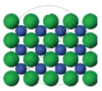
| Figure 1 | Figure 2 | Figure 3 |
 |
 |
 |
The arrangement of particles in three different phases of matter is shown above.
- Which state is represented by Fig. 1?
- In which state will the inter-particle attraction be maximum?
- Which one of them cannot be contained in an open vessel?
- Which one can take the shape of its container?
State whether true or false. If false, correct the statement.
Oil and water are immiscible with each other.
The particles in the matter are extremely small and can be seen even with a powerful microscope.
Solids possess very high kinetic energy.
Define the term matter.
