Advertisements
Advertisements
प्रश्न
Define the following:
Clone
एक पंक्ति में उत्तर
Advertisements
उत्तर
Clone: It is a group of genetically identical cells or organisms asexually descended from a common ancestor.
shaalaa.com
क्या इस प्रश्न या उत्तर में कोई त्रुटि है?
संबंधित प्रश्न
Describe, in brief, the changes the uterus undergoes
(i) to receive the zygote.
(ii) if zygote is not formed
Write the functions of the following parts in human female reproductive system:-
(i) Ovary
(ii) Oviduct
(iii) Uterus
When a cell reproduces, what happens to its DNA?
Match the Column:
| no | Column A | Column B |
| 1 | Allele | Control of automobile exhaust |
| 2 | Leydig cells | Tourniquet |
| 3 | Utriculus | Alternate forms of genes |
| 4 | Snake bite | Dynamic equilibrium |
| 5 | Euro IV norms | Testosterone |
| Sudden change in genes | ||
| Static equilibrium |
Name the liquid that contains sperms.
Name the organs which produce ova (or egg cells) in human females.
Write two examples of sexually transmitted diseases caused by bacteria.
Identify the given diagram.
Name the parts 1 to 5. 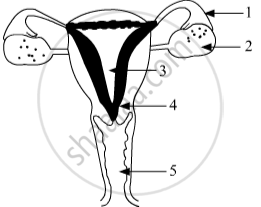
Explain the term Parturition or birth.
Mention, if the following statement is True or False. If false rewrite the wrong statement in its correct form:
A zygote is the product of the fusion of male and female gametes.
