Advertisements
Advertisements
प्रश्न
Define equilibrium.
Advertisements
उत्तर
When several forces acting on a body produce no change in its state of rest or motion, the body is said to be in equilibrium.
APPEARS IN
संबंधित प्रश्न
State the principle of moments. A meter scale is pivoted at 30 cm mark and it is in equilibrium when a mass of 40 g is suspended from 10 cm mark. Calculate the mass of the ruler.
Give scientific reason for the following:
When a man climbs a slope he bends forward.
Give scientific reason for the following:
While climbing a hill you will try to bend your body forward.
The moon revolving around the earth is in ______ equilibrium.
State the principle of moments.
What is the weight of a body placed at the centre of the earth?
What is meant by equilibrium?
What do you mean by dynamic and static equilibrium? Give one example of each.
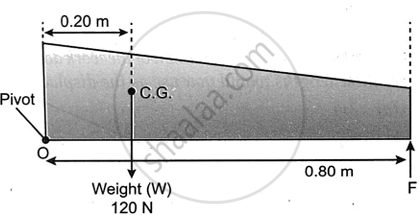
A non uniform beam of weight 120 N pivoted at one end is shown in the diagram below. Calculate the value of F to keep the beam in equilibrium.