Advertisements
Advertisements
प्रश्न
Define Bohr effect and Haldane effect.
टिप्पणी लिखिए
Advertisements
उत्तर
- Bohr effect: Bohr effect is the shift of oxyhaemoglobin dissociation curve due to change in partial pressure of CO2 in blood.
- Haldane effect: The amount of CO2 that can be transported in the blood is influenced by the percent saturation of haemoglobin with oxygen. The lower the amount of oxyhaemoglobin (Hb-O2), the higher the CO2 carrying capacity of the blood, this relationship is known as the Haldane effect.
shaalaa.com
क्या इस प्रश्न या उत्तर में कोई त्रुटि है?
APPEARS IN
संबंधित प्रश्न
Why do we often sneeze when we inhale a lot of dust-laden air?
Normal range of breathing rate per minute in an average adult person at rest is ______.
In human respiration, chemical energy is released in the form of ______.
Explain why you are not able to breathe normally when you are in closed and crowded places?
Intercostal muscles are found between the ______.
Make the correct pairs.
| Column – I | Column – II |
| (P) Tidal volume | i. 1000 to 1100 ml |
| (Q) Residual volume | ii. 500 ml |
| (R) Expiratory reserve volume | iii. 2500 to 3000 ml |
| (S) Inspiratory reserve volume | iv. 1100 to 1200 ml |
During inspiration, the inter-costal muscles ____________.
Whenever we feel drowsy or sleepy, we start yawning. Does yawning help us in any way?
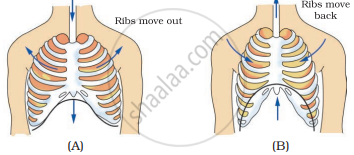
Observe the figures given in figure (A) and (B) and answer the following.
- Which of the figures A or B indicates the process of inhalation and which the process of exhalation?
- In the figure label the arrows and indicate the direction of
- movement of air
- movement of diaphragm
- movement of ribs
What is phosphorylation?
