Advertisements
Advertisements
प्रश्न
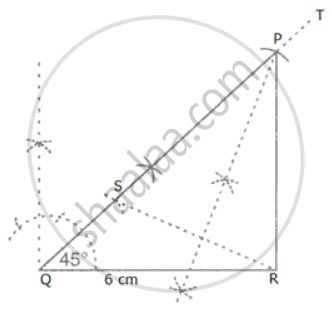
Construct a triangle using the given data: PQ - PR = 1.5 cm, QR = 6.0 and ∠Q = 45°
Advertisements
उत्तर
PQ - PR = 1.5 cm, QR = 6.0 and ∠Q = 45°
Steps of Construction:
1. Draw a line segment QR = 6 cm.
2. With Q as centre, draw ∠TQR = 45°
3. From QT, cut QS = 1.5 cm.
4. Join S and R.
5. Draw perpendicular bisector of SR which cuts QT at P.
6. Join PR.
Thus, PQR is the required triangle.
APPEARS IN
संबंधित प्रश्न
In ΔABC, l(AB) = 5.5 cm, l(BC) = 4.2 cm, l(AC) = 3.5 cm
Construct a triangle of the measures given below.
In ∆ABC, l(AC) = 7.5 cm, m ∠ABC = 90°, l(BC) = 5.5 cm.
Construct ∆ABC such that m∠A = 55°, m∠B = 60°, and l(AB) = 5.9 cm.
Construct ∆XYZ such that l(XY) = 3.7 cm, l(YZ) = 7.7 cm, l(XZ) = 6.3 cm.
Construct a right-angled triangle in which: QP = QR and hypotenuse PR = 7 cm
Construct an equilateral triangle using the given data: Altitude AD = 5 cm
Construct a triangle using the following data: XY + YZ = 5.6 cm, XZ = 4.5 cm and ∠X = 45°
Construct a triangle using the given data: AB - AC = 1.2 cm, BC = 6.0 cm and ∠B = 60°
For constructing △XYZ where XY = 6 cm, YZ = 5 cm, and XZ = 4 cm, which construction method should be used?
In Construction of triangle ABC where AB = 3 cm, BC = 5 cm, and ∠ABC = 60°, which side must be drawn first as the base?
