Advertisements
Advertisements
प्रश्न
Consider the reaction of water with F2 and suggest, in terms of oxidation and reduction, which species are oxidized/reduced.
Advertisements
उत्तर
The reaction between fluorine and water can be represented as:
\[\ce{2F_{2(g)} + 2H_2O_{(l)} -> 4H^+_{(aq)} + 4F^-_{(aq)} + O_{2(g)}}\]
This is an example of a redox reaction as water is getting oxidized to oxygen, while fluorine is being reduced to fluoride ion.
The oxidation numbers of various species can be represented as:
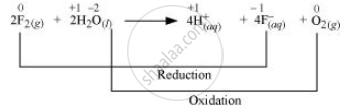
Fluorine is reduced from zero to (- 1) oxidation state. A decrease in oxidation state indicates the reduction of fluorine.
Water is oxidized from (- 2) to zero oxidation state. An increase in oxidation state indicates oxidation of water.
संबंधित प्रश्न
Complete the following chemical reaction.
\[\ce{PbS_{(s)} + H_2O_{2(aq)} ->}\] ______
Classify the chemical reaction into (a) hydrolysis, (b) redox and (c) hydration reactions.
Complete the following chemical reaction.
\[\ce{CaO_{(s)} + H_2O_{(g)} ->}\]?
Classify the chemical reaction into (a) hydrolysis, (b) redox and (c) hydration reactions.
Complete the following chemical reaction.
\[\ce{AlCl_{3(g)} + H_2O_{(l)} ->}\] ?
Classify the chemical reaction into (a) hydrolysis, (b) redox and (c) hydration reactions.
Write chemical reactions to show the amphoteric nature of water.
Do you expect different products in solution when aluminium (III) chloride and potassium chloride treated separately with (i) normal water (ii) acidified water, and (iii) alkaline water? Write equations wherever necessary.
Why is water used in hot-water bottles?
How the temporary and permanent hardness is removed?
Give a reason why metals are arranged in a series called – ‘activity series of metals’. Name a metal which reacts with
(a) Cold water
(b) Boiling water
(c) Steam to liberate hydrogen in each case.
Give a balanced equation for the following conversion:
Iron to triiron tetroxide using steam.
How does it occur in the free state and in the combined state.
State a reason to prove that water is a compound and not a element.
The density of water is maximum at ________.
How can production of hydrogen from water gas be increased by using water gas shift reaction?
Write a short note on the catalytic nature of water.
Polyphosphates are used as water softening agents because they ______.
