Advertisements
Advertisements
प्रश्न
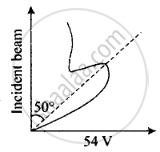
Consider figure in the NCERT textbook of physics for Class XII. Suppose the voltage applied to A is increased. The diffracted beam will have the maximum at a value of θ that ______.
विकल्प
will be larger than the earlier value.
will be the same as the earlier value.
will be less than the earlier value.
will depend on the target.
Advertisements
उत्तर
Consider figure in the NCERT textbook of physics for Class XII. Suppose the voltage applied to A is increased. The diffracted beam will have the maximum at a value of θ that will be less than the earlier value.
Explanation:
Davision and Germer Experiment:
1. It is used to study the scattering of electron from a solid or to verify the wave nature of electron. A beam of electrons emitted by an electron gun is made to fall on a nickel crystal cut along the cubical axis at a particular angle. Ni crystal behaves like a three-dimensional diffraction grating and it diffracts the electron beam obtained from electron gun.
2. The diffracted beam of electrons is received by the detector which can be positioned at any angle by rotating it .about the point of incidence. The energy of the incident beam of electrons can also be varied by changing the applied voltage to the electron gun.
According to classical physics, the intensity of scattered beams of electrons at all scattering angles will be the same but Davisson and Germer found that the intensity of scattered beams of electrons was not the same but different at different angles of scattering. It is maximum for diffracting angle 50° at 54-volt potential difference.
3. If the de-Broglie waves exist for electrons then these should be diffracted as X-rays. Using Bragg’s formula 2d sinθ = nλ, we can determine the wavelength of these waves.
The de-Broglie wavelength associated with the electron is where V is the applied voltage. Using Bragg’s formula we can determine the wavelength of these waves. If there is a maximum of the, diffracted electrons at an angle θ, then 2d sin θ = A
From equation (i), we note that if V is inversely proportional to the wavelength λ. i.e., V will increase with the decrease, in λ.
From equation (ii), we note that wavelength λ is directly proportional to sinθ and hence θ.
So, with the decrease in λ, θ will also decrease.
Thus, when the voltage applied to A is increased. The diffracted beam will have the maximum at a value of θ that will be less than the earlier value.
4. A proton, a neutron, an electron and an a-particle have the same energy. Then, their de-Broglie wavelengths compare as
The de-Broglie wavelength associated with the electron is `λ = 12.27/sqrt(V) Å` ......(i)
Where V is the applied voltage.
Using Bragg's formula we can determine the wavelength of these waves.
If there is a maximum of the diffracted electrons at an angle θ, then 2d sin θ = λ ......(ii)
From equation (i), we note that If V is inversely proportional to the wavelength λ.
i.e., V will increase with the decrease in λ.
From equation (ii), we note that wavelength λ is directly proportional to sin θ and hence θ.
So, with the decrease in λ, θ will also decrease.
Thus, when the voltage applied to A is increased. The diffracted beam will have the maximum at a value of θ that will be less than the earlier value.
