Advertisements
Advertisements
प्रश्न
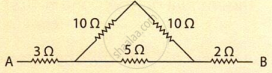
Calculate the equivalent resistance of the given circuit diagram.
Advertisements
उत्तर
Given Data:
Left resistor = 3 Ω
Middle resistor = 5 Ω
Right resistor = 2 Ω
Two upper resistors = 10 Ω each
1. Simplify the upper branch:
The two 10 Ω resistors in the triangular upper branch are connected end-to-end in a series combination:
R1 = 10 Ω + 10 Ω
= 20 Ω
Now, this simplified 20 Ω branch is connected across the same common junctions in a parallel combination with the central 5 Ω resistor.
Let the equivalent resistance of this parallel network be Rp:
`1/R_p = 1/20 + 1/5`
`1/R_p = 1/20 + 4/20`
`1/R_p = 5/20`
`1/R_p = 1/4`
Rp = 4 Ω
2. Calculation of the total equivalent resistance (RAB):
Since the initial 3 Ω resistor, the simplified central parallel network (Rp = 4 Ω), and the final 2 Ω resistor are all connected consecutively in a series combination:
RAB = 3 Ω + 4 Ω + 2 Ω
= 9 Ω
The total equivalent resistance of the given circuit between points A and B is 9 Ω.
