Advertisements
Advertisements
प्रश्न
Calculate the area of the shaded portion. The quadrants shown in the figure are each of radius 7 cm.
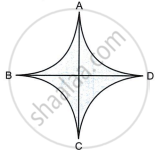
Advertisements
उत्तर
Given:
- Four quadrants each of radius 7 cm.
- The shaded region is the overlapping central part formed by these quadrants.
Step-wise calculation:
1. Each quadrant has radius r = 7 cm.
2. The shape formed by the quadrants is symmetrical the points of intersection create a square inside the figure.
3. The diagonal of this square corresponds to the diameter of the quadrants, which is 14 cm.
4. Using the square diagonal formula:
Side of square = `"Diagonal"/sqrt(2)`
= `14/sqrt(2)`
= `7sqrt(2)` cm
5. Area of the square = Side2
= `(7sqrt(2))^2`
= 49 × 2
= 98 cm2
6. The shaded region is only part of the square, specifically the area within the quadrant arcs.
7. The shaded area can be calculated as:
Shaded area = Area of square – Area outside the quadrants
8. The part outside the intersection corresponds to four small circular segments.
9. Each segment’s area = area of quadrant sector – area of the right triangle formed by radius lines.
10. Area of one quadrant:
`1/4 πr^2 = 1/4 xx π xx 7^2`
= `(49π)/4`
11. Area of right triangle inside quadrant:
`1/2 xx 7 xx 7 = 49/2`
12. Area of one segment:
Segment area = `(49π)/4 - 49/2`
= `49/4 (π - 2)`
13. Total area of four such segments:
4 × Segment area
= `4 xx 49/4 (π - 2)`
= 49(π – 2)
14. Since the shaded portion is the total area of the square minus these four segments:
Shaded area = 98 – 49(π – 2)
= 98 – 49π + 98
= 196 – 49π
15. Using π ≈ 3.14:
196 – 49 × 3.14
= 196 – 153.86
= 42.14 cm2
The area of the shaded portion is approximately 42 cm2.
