Advertisements
Advertisements
प्रश्न
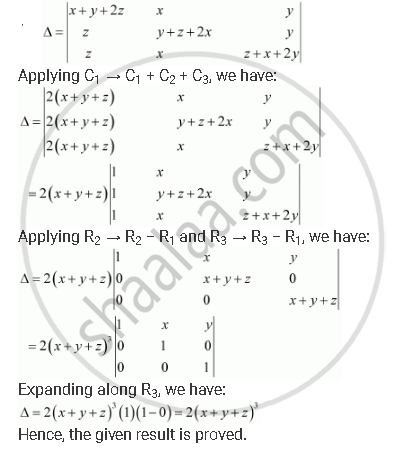
By using properties of determinants, show that:
`|(x+y+2z, x, y),(z, y+z+2z,y),(z,x,z+x+2y)| = 2(x+y+z)^3`
Advertisements
उत्तर

APPEARS IN
संबंधित प्रश्न
Using properties of determinants prove the following: `|[1,x,x^2],[x^2,1,x],[x,x^2,1]|=(1-x^3)^2`
Using properties of determinants, show that ΔABC is isosceles if:`|[1,1,1],[1+cosA,1+cosB,1+cosC],[cos^2A+cosA,cos^B+cosB,cos^2C+cosC]|=0`
Using the property of determinants and without expanding, prove that:
`|(b+c, q+r, y+z),(c+a, r+p, z +x),(a+b, p+q, x + y )| = 2|(a,p,x),(b,q,y),(c, r,z)|`
By using properties of determinants, show that:
`|(0,a, -b),(-a,0, -c),(b, c,0)| = 0`
By using properties of determinants, show that:
`|(1,a,a^2),(1,b,b^2),(1,c,c^2)| = (a - b)(b-c)(c-a)`
By using properties of determinants, show that:
`|(x,x^2,yz),(y,y^2,zx),(z,z^2,xy)| = (x-y)(y-z)(z-x)(xy+yz+zx)`
By using properties of determinants, show that:
`|(x+4,2x,2x),(2x,x+4,2x),(2x , 2x, x+4)| = (5x + 4)(4-x)^2`
Without expanding the determinant, prove that
`|(a, a^2,bc),(b,b^2, ca),(c, c^2,ab)| = |(1, a^2, a^3),(1, b^2, b^3),(1, c^2, c^3)|`
Using properties of determinants, prove that `|(x,x+y,x+2y),(x+2y, x,x+y),(x+y, x+2y, x)| = 9y^2(x + y)`
Using properties of determinants, prove that `|(1,1,1+3x),(1+3y, 1,1),(1,1+3z,1)| = 9(3xyz + xy + yz+ zx)`
Using properties of determinants, prove that:
`|(1+a^2-b^2, 2ab, -2b),(2ab, 1-a^2+b^2, 2a),(2b, -2a, 1-a^2-b^2)| = (1 + a^2 + b^2)^3`
Using properties of determinants, prove that:
`|(a,b,b+c),(c,a,c+a),(b,c,a+b)|` = (a+b+c)(a-c)2
Using properties of determinants, prove that:
`|[a^2 + 1, ab, ac], [ba, b^2 + 1, bc ], [ca, cb, c^2+1]| = a^2 + b^2 + c^2 + 1`
Using properties of determinant prove that
`|(b+c , a , a), (b , c+a, b), (c, c, a+b)|` = 4abc
Without expanding the determinants, show that `|(l, "m", "n"),("e", "d", "f"),("u", "v", "w")| = |("n", "f", "w"),(l, "e", "u"),("m", "d", "v")|`
If `|(4 + x, 4 - x, 4 - x),(4 - x,4 + x,4 - x),(4 - x,4 - x, 4 + x)|` = 0, then find the values of x.
Answer the following question:
Evaluate `|(101, 102, 103),(106, 107, 108),(1, 2, 3)|` by using properties
The value of `|(1, 1, 1),(""^"n""C"_1, ""^("n" + 2)"C"_1, ""^("n" + 4)"C"_1),(""^"n""C"_2, ""^("n" + 2)"C"_2, ""^("n" + 4)"C"_2)|` is 8.
Evaluate: `|("a" + x, y, z),(x, "a" + y, z),(x, y, "a" + z)|`
Prove that: `|("a"^2 + 2"a", 2"a" + 1, 1),(2"a" + 1, "a" + 2, 1),(3, 3, 1)| = ("a" - 1)^3`
If A + B + C = 0, then prove that `|(1, cos"c", cos"B"),(cos"C", 1, cos"A"),(cos"B", cos"A", 1)|` = 0
If cos2θ = 0, then `|(0, costheta, sin theta),(cos theta, sin theta,0),(sin theta, 0, cos theta)|^2` = ______.
If the determinant `|(x + "a", "p" + "u", "l" + "f"),("y" + "b", "q" + "v", "m" + "g"),("z" + "c", "r" + "w", "n" + "h")|` splits into exactly K determinants of order 3, each element of which contains only one term, then the value of K is 8.
Let P be any non-empty set containing p elements. Then, what is the number of relations on P?
If the ratio of the H.M. and GM. between two numbers a and bis 4 : 5, then a: b is
In a third order matrix B, bij denotes the element in the ith row and jth column. If
bij = 0 for i = j
= 1 for > j
= – 1 for i < j
Then the matrix is
The A.M., H.M. and G.M. between two numbers are `144/15`, 15 and 12, but not necessarily in this order then, H.M., G.M. and A.M. respectively are
Let 'A' be a square matrix of order 3 × 3, then |KA| is equal to:
The value of the determinant `|(1, cos(β - α), cos(γ - α)),(cos(α - β), 1, cos(γ - β)),(cos(α - γ), cos(β - γ), 1)|` is equal to ______.
Let a, b, c be such that b(a + c) ≠ 0 if
`|(a, a + 1, a - 1),(-b, b + 1, b - 1),(c, c - 1, c + 1)| + |(a + 1, b + 1, c - 1),(a - 1, b - 1, c + 1),((-1)^(n + 2)a, (-1)^(n + 1)b, (-1)^n c)|` = 0, then the value of n is ______.
If f(α) = `[(cosα, -sinα, 0),(sinα, cosα, 0),(0, 0, 1)]`, prove that f(α) . f(– β) = f(α – β).
Without expanding determinants find the value of `|(10,57,107), (12, 64, 124), (15, 78, 153)|`
Without expanding determinants find the value of `|(10,57,107),(12,64,124),(15,78,153)|`
Without expanding evaluate the following determinant:
`|(1, a, b + c), (1, b, c + a), (1, c, a + b)|`
Without expanding determinants, find the value of `|(10, 57, 107), (12, 64, 124), (15, 78, 153)|`
By using properties of determinants, prove that
`|(x+y, y+z, z+x),(z, x, y),(1, 1, 1)|` = 0
Without expanding determinant find the value of `|(10, 57, 107),(12, 64, 124),(15, 78, 153)|`
Without expanding determinants, find the value of `|(10, 57, 107),(12, 64, 124),(15, 78, 153)|`
