Advertisements
Advertisements
प्रश्न
Buckminsterfullerene is spherical molecule in which 60 carbon atoms are arranged in interlocking hexagonal and pentagonal rings of carbon atoms.
How many hexagons of carbon atoms are present in one molecule of buckminsterfullerene?
Advertisements
उत्तर
In one molecule of buckminsterfullerene, 20 hexagons of carbon atoms are present.
APPEARS IN
संबंधित प्रश्न
Fill in the blank in the following sentence:
The number of single covalent bonds in C2H2 molecule are ...........
What is a covalent bond?
Give two general properties of ionic compounds and two those of covalent compounds.
Which inert gas does the H atom in HCl resemble in electron arrangement?
Explain why, diamond can be used in rock drilling equipment but graphite cannot.
Which of the following cannot exhibit isomerism?
(a) C4H10
(b) C5H12
(c) C3H8
(d) C6H14
What happens when methane (natural gas) burns in air? Write the chemical equation of the reaction involved.
What is the difference between ionic compounds and polar covalent compounds?
Give the characteristic properties of covalent compounds.
State the type of bonding in the following molecule.
Hydroxyl ion
Give two example in following case:
Solid covalent compounds
Draw all possible structural formulae of compound from their molecular formula given below.
C3H8
Explain the following briefly.
Pure water does not conduct electricity, but on adding sodium chloride to it, it starts conducting electricity.
Choose the correct answer from the options given below
Condition favorable for formation of a covalent bond is
Potassium (Atomic No. 19) and chlorine (Atomic No. 17) react to form a compound. On the basis of electronic concept, explain
(i) oxidation
(ii) reduction
(iii)oxidising agent
(iv)reducing agent
Complete the following activity.
Write the names of the hydrocarbons for the following structural formula.
(isobutylene, cyclohexane, propene, cyclohexene, cyclopentane, benzene, propyne, isobutane, propane)
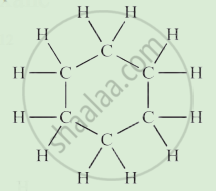 |
Complete the following activity.
Write the names of the hydrocarbons for the following structural formula.
(isobutylene, cyclohexane, propene, cyclohexene, cyclopentane, benzene, propyne, isobutane, propane)
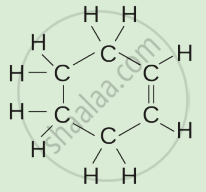 |
The correct structural formula of butanoic acid is -
Carbon forms four covalent bonds by sharing its four valence electrons with four univalent atoms, e.g., hydrogen. After the formation of four bonds, carbon attains the electronic configuration of ______.
The I.U.P.A.C name of CH3CH2CH = CH2 is?
