Advertisements
Advertisements
प्रश्न
Briefly describe the following term giving one example:
Polyesters
Advertisements
उत्तर
The polymers having ester linkages are called polyesters. Dicarboxylic acids and diols undergo condensation polymerization to create these. The following are some significant polymers that fall within this class. combs, brush handles, toys, wall tiles, television coils, etc.
Terylene or Dacron: It is a copolymer of terephthalic acid and ethylene glycol. Terephthalic acid and ethylene glycol are condensation polymerized at about 475K to produce it.
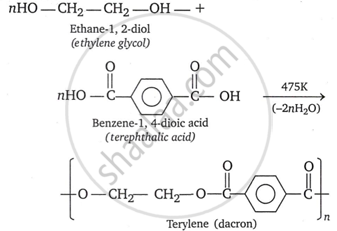
Terephthalic acid is actually first transformed into dimethyl ester. After that, the dimethyl ester is treated with excess glycol in an inert environment at roughly 473K while a catalyst is present. The resulting diglycol terephthalate is heated to 473K under air pressure for approximately 30 minutes. To finish the polymerization, it is heated further at 523-533K under lower pressure.
Terylene produces robust fibers. Textiles are manufactured using Terylene fibers. Terylene-based fibers and textiles have a number of advantageous qualities. They have less stretching, absorb less moisture, and feel warm to the touch. Whether they are wet or dry, they keep their crease and shape. They are unaffected by changes in the atmosphere and are simple to wash. They cannot be spoiled by insects, moths, etc.
In the textile sector, Terylene has gained a lot of popularity because of these special qualities. It can also be mixed with cotton and wool, among other fibers. Also, Terylene has been utilized in movies titled Mylar. This polymer’s films have a high tensile strength and are resistant to tearing. Magnetic tapes are also made with it.
Glyptal or Alkyd resin: It is a polymer of ethylene glycol and phthalic acid. It is prepared by the condensation polymerisation of phthalic acid with ethylene glycol.
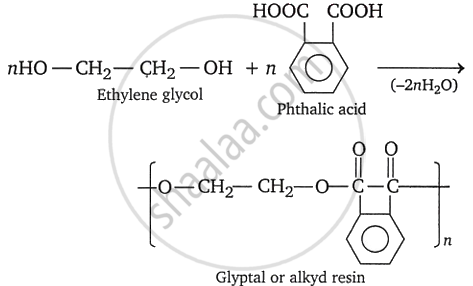
It dissolves in the right solvents and forms a hard, non-flexible film when the solution evaporates. As a result, paints and lacquers are made with it.
