Advertisements
Advertisements
प्रश्न
|
Born in 1754, Colin Mackenzie became famous as an engineer, surveyor and cartographer. In 1815, he was appointed the first Surveyor General of India, a post he held till his death in 1821. He embarked on collecting local histories and surveying historic sites in order to better understand India’s past and make governance of the colony easier. He says that “it struggled long under the miseries of bad management … before the South came under the benign influence of the British government”. By studying Vijayanagara, Mackenzie believed that the East India Company could gain “much useful information on many of these institutions, laws and customs whose influence still prevails among the various Tribes of Natives forming the general mass of the population to this day.”
Mackenzie and his assistants This is a copy by an unknown artist of an oil painting by the portrait painter Thomas Hickey. It dates to c.1825 and belongs to the collection of the Royal Asiatic Society of Britain and Ireland. On Mackenzie’s left is his peon Kistnaji holding a telescope; on his right are Brahmana assistants – a Jaina pandit (right) and behind him the Telugu Brahmana Cauvellery Ventak Letchmiah. |
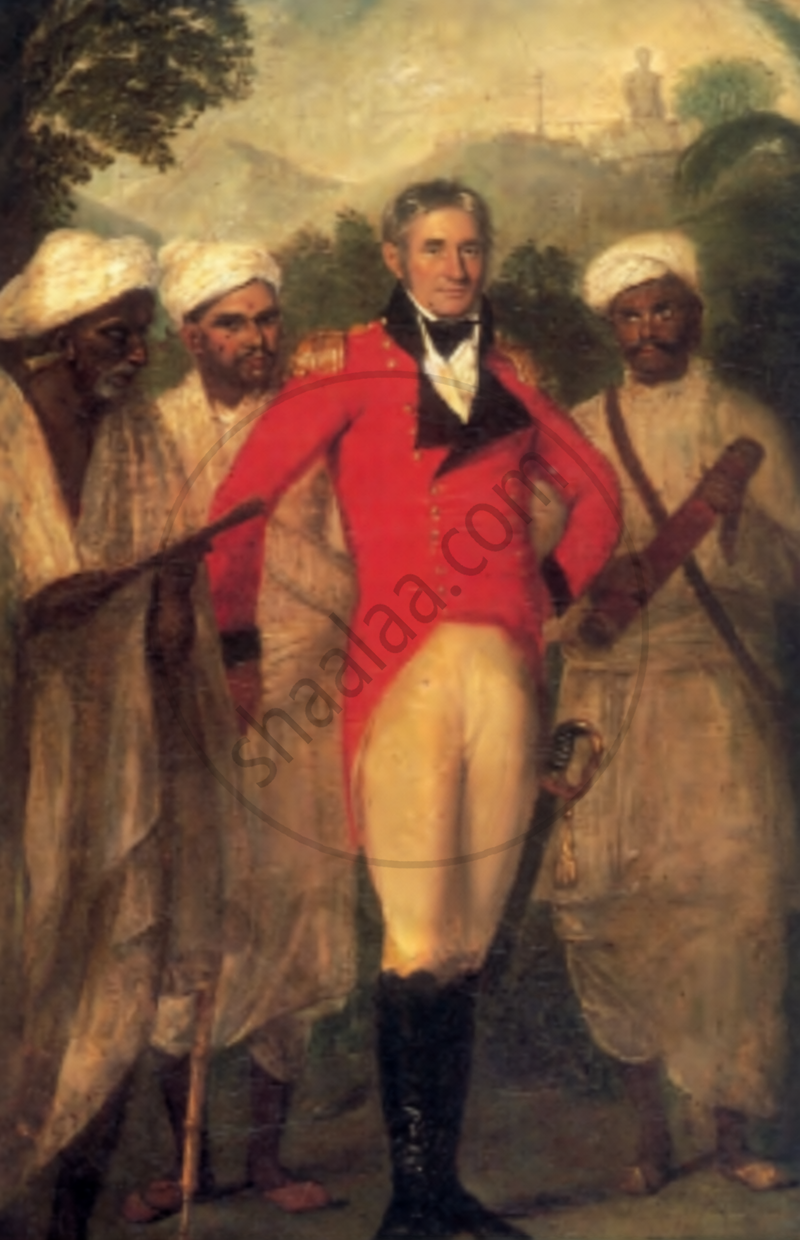
- How has the artist portrayed Mackenzie and his indigenous informers?
- What ideas about him and his informants are sought to be impressed upon the viewers?
Advertisements
उत्तर
- The artist portrayed Mackenzie and his indigenous informers in the following way:
- Central Position: Colin Mackenzie is placed right in the centre of the painting, making him the most prominent figure.
- Confident Stature: He is depicted standing tall and dressed in a formal European military/colonial uniform, projecting power and leadership.
- Subordinate Informants: His local assistants and attendants are positioned around him or slightly behind him, highlighting a clear hierarchy.
- Symbols of Roles: His peon, Kistnaji, is shown holding a telescope to signify observation, while the Jaina pandit and Telugu Brahmana are placed as keepers of traditional knowledge.
- The ideas which are sought to be impressed upon the viewers are as follows:
- Colonial Superiority: The composition is designed to impress upon the viewer that the British official is the active, superior supervisor commanding the project.
- Dependence on Native Knowledge: It shows that while the British managed the governance and cartography, they relied heavily on local scholars and administrators to decode India’s past.
- Enlightened Imperialism: It reinforces the British narrative of bringing order, modern scientific survey tools (like the telescope), and systematic documentation to the colonies.
