Advertisements
Advertisements
प्रश्न
Boojho stands at A just on the side of a plane mirror as shown in figure. Can he see himself in the mirror? Also can he see the image of objects situated at P, Q and R?

Advertisements
उत्तर
A plane mirror forms a virtual image behind the mirror. The image is as far behind the mirror as the object is in front of it. A cannot see his image because the length of the mirror is too short on his side. However, he can see the objects placed at points P and Q but cannot see the objects placed at point R (as shown in the given figure).

संबंधित प्रश्न
A person 1 m in front of a plane mirror seems to be ______ m away from his image.
Angle of incidence is equal to the angle of reflection.
What is the angle of incidence of a ray if the reflected ray is at an angle of 90° to the incident ray?
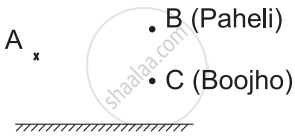
- Find out the position of the image of an object situated at A in the plane mirror.
- Can Paheli at B see this image?
- Can Boojho at C see this image?
- When Paheli moves from B to C, where does the image of A move?
State the two laws of reflection of light.
State the two laws of reflection of light.
According to the law of reflection :
State the laws of reflection.
With the help of a diagram, state the laws of reflection
A student does the experiment on tracing the path of a ray of light passing through a rectangular glass slab for different angles of incidence. He can get a correct measure of the angle of incidence and the angle of emergence by following the labelling indicated in figure.
