Advertisements
Advertisements
प्रश्न
Bond angle in `PH_(4)^(+)` is higher than that in PH3. Why?
Advertisements
उत्तर १
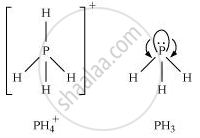
In PH3, P is sp3 hybridized. Three orbitals are involved in bonding with three hydrogen atoms and the fourth one contains a lone pair. As lone pair-bond pair repulsion is stronger than bond pair-bond pair repulsion, the tetrahedral shape associated with sp3 bonding is changed to pyramidal. PH3 combines with a proton to form `PH_4^(+)` in which the lone pair is absent. Due to the absence of lone pair in `PH_4^(+)`, there is no lone pair-bond pair repulsion. Hence, the bond angle in is higher than the bond angle in PH3
उत्तर २
P in PH3 is sp3-hybridized with 3 bond pairs and one lone pair around P. Due to stronger lp-bp repulsions than bp-bp repulsions, tetrahedral angle decreases from 109°28′ to 93.6°. As a result, PH3 is pyramidal. In PH4+, there are 4 bp’s and no lone pair. As a result, there are only identical bp-bp repulsions so that PH4+ assumes tetrahedral geometry and the bond angle is 109°28′.Hence, bond angle of PH4+ > bond angle of PH3
संबंधित प्रश्न
Write balanced chemical equations for action of potassium permanganate on: Hydrogen
Pb(NO3)2 on heating gives a brown gas which undergoes dimerisation on cooling? Identify the gas
Why does NO2 dimerise?
What is the covalence of nitrogen in N2O5?
Why does the reactivity of nitrogen differ from phosphorus?
Which of the following is a basic oxide?
(A) SiO2
(B) P4O10
(C) MgO
(D) Al2O3
Explain why Mn2+ ion is more stable than Mn3+? (Given : Mn→ Z=25)
Tendency to show –3 oxidation state decrease from Nitrogn (N) to Bismuth (Bi).
The statement true for \[\ce{N^-_3}\] is ____________.
Nitrogen is relatively inactive element because ____________.
Pick out the wrong statement.
In which one of the following oxides of nitrogen, one nitrogen atom is not directly linked to oxygen?
Which oxide of nitrogen is obtained on heating ammonium nitrate at 250°C?
A deep brown gas is formed by mixing two colourless gases which are:
The laughing gas is ____________.
Which of the following elements can be involved in pπ – dπ bonding?
Assertion: \[\ce{HNO3}\] makes iron passive.
Reason: \[\ce{HNO3}\] forms a protective layer of ferric nitrate on the surface of iron.
Assertion: Nitrogen and oxygen are the main components in the atmosphere but these do not react to form oxides of nitrogen.
Reason: The reaction between nitrogen and oxygen requires high temperature.
