Advertisements
Advertisements
प्रश्न
Assertion: If square ABCD and ΔPQR have same perimeter then QR = 8 cm.
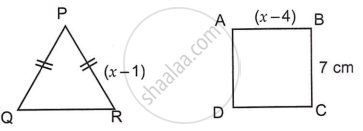
Reason: Perimeter = 28 cm, x = 11.
विकल्प
Both A and R are true and R is the correct reason for A.
Both A and R are true but R is the incorrect reason for A.
A is true but R is false.
A is false but R is true.
Advertisements
उत्तर
Both A and R are true and R is the correct reason for A.
Explanation:
Given:
- Square ABCD and triangle PQR have the same perimeter.
- Perimeter = 28 cm.
- x = 11.
Step 1: Perimeter of square ABCD
Side of square ABCD
= (x – 4) cm
= (11 – 4) cm
= 7 cm
Perimeter of square
= 4 × 7
= 28 cm
So, the square’s perimeter is 28 cm.
Step 2: Perimeter of triangle PQR
Triangle PQR has sides PQ, QR, PR
Given: PQ = QR ...(Marked equal)
QR = 8 cm ...(From assertion)
PQ = 8 cm
PR = (x – 1) cm
= 11 – 1
= 10 cm
Perimeter of triangle = PQ + QR + PR
= 8 + 8 + 10
= 26 cm
At first glance, this indicates the triangle’s perimeter is 26 cm, which is not equal to 28 cm square’s perimeter.
Step 3: Reevaluating the condition of same perimeter
The assertion states “If square ABCD and ΔPQR have the same perimeter”, which means:
Perimeter of square ABCD = Perimeter of ΔPQR.
We have the square’s perimeter as 28 cm.
Let’s check if this perimeter equality implies QR = 8 cm.
Step 4: Express triangle’s perimeter in terms of QR
Since PQ = QR ...(Isosceles triangle),
Let QR = PQ = y cm,
PR = (x – 1) = 10 cm with x = 11.
Triangle perimeter = PQ + QR + PR
= y + y + 10
= 2y + 10
Set this equal to the square’s perimeter:
2y + 10 = 28
2y = 18
y = 9 cm
For the triangle to have the same perimeter as the square 28 cm, QR must be 9 cm, not 8 cm.
But the assertion says QR = 8 cm if they have the same perimeter, which contradicts the calculation.
