Advertisements
Advertisements
प्रश्न
Answer of these question in a short paragraph (about 30 words).
How does the author describe: (i) his father, (ii) his mother, (iii) himself?
Advertisements
उत्तर
(i) Kalam’s father, Jainulabdeen was not a wealthy or educated person. However, he was an honest and generous man, who possessed great innate wisdom. He was self-disciplined and avoided all inessential luxuries.
(ii) Kalam’s mother, Ashiamma was an ideal helpmate to her husband. She believed in goodness and profound kindness, and fed many people everyday.
(iii) The author describes himself as a short boy with undistinguished looks, who had a secure childhood. He is an honest and self-disciplined person, who believes in goodness and deep kindness.
संबंधित प्रश्न
Answer of these question in a short paragraph (30–40 words).
Who helped her to continue with music? What did he do and say?
Lushkoff is earning thirty five roubles a month. How is he obliged to Sergei for this?
"My father lived at Blenheim then,
Yon little stream hard by;
They burnt his dwelling to the ground,
And he was forced to fly;
So with his wife and child he fled,
Nor had he where to rest his head.
"With fire and sword the country round
Was wasted far and wide,
And many a childing mother then,
And new-born baby died;
But things like that, you know, must be
At every famous victory;
Read the lines given above and answer the question that follow.
Kaspar describes the horrors of war but how can his attitude be described?
“You haven’t brought home that sick brat!” Anger and astonishment were in the tones of Mrs. Joe Thompson; her face was in a flame.
“I think women’s hearts are sometimes very hard,” said Joe. Usually Joe Thompson got out of his wife’s way, or kept rigidly silent and non-combative when she fired up on any subject; it was with some surprise, therefore, that she now encountered a firmly-set countenance and a resolute pair of eyes.
“Women’s hearts are not half so hard as men’s!”
Joe saw, by a quick intuition, that his resolute bearing h«d impressed his wife and he answered quickly, and with real indignation, “Be that as it may, every woman at the funeral turned her eyes steadily from the sick child’s face, and when the cart went off with her dead mother, hurried away, and left her alone in that old hut, with the sun not an hour in the sky.”
“Where were John and Kate?” asked Mrs. Thompson.
“Farmer Jones tossed John into his wagon, and drove off. Katie went home with Mrs. Ellis; but nobody wanted the poor sick one. ‘Send her to the poorhouse,’ was the cry.”
“Why didn’t you let her go, then. What did you bring her here for?”
“She can’t walk to the poorhouse,” said Joe; “somebody’s arms must carry her, and mine are strong enough for that task.”
Read the extract given below and answer the question that follow.
Does the attitude of the villagers convey some truth about society at large?
Then, trying to hide my nervousness, I added, “How are you?”
“I’m fine. The question is: How are you?“
“What do you mean?” 1 asked “Something must be eating you,” he said—proud the way foreigners are when they’ve mastered a bit of American slang. “You should be able to qualify with your eyes closed.”
“Believe me, I know it,” I told him—and it felt good to say that to someone.
For the next few minutes we talked together. I didn’t tell Long what was “eating” me, but he seemed to understand my anger, and he took pains to reassure me. Although he’d been schooled in the Nazi youth movement, he didn’t believe in the Aryan-supremacy business any more than I did. We laughed over the fact that he really looked the part, though. An inch taller than I, he had a lean, muscular frame, clear blue eyes, blond hair and a strikingly handsome, chiseled face. Finally, seeing that I had calmed down somewhat, he pointed to the take-off board.
“Look,” he said. “Why don’t you draw a line a few inches in back of the board and aim at making your take-off from there? You’ll be sure not to foul, and you certainly ought to jump far enough to qualify. What does it matter if you’re not first in the trials? Tomorrow is what counts.”
Read the extract given below and answer the question that follow.
How did Owens manage to qualify for the finals with a foot to spare?
What information does Gilman give to Twisden? Why did Twisden decide to withdraw from the case ?
Complete the sentence below by appropriately using anyone of the following:
if you want to/if you don’t want to/if you want him to
Don’t go to the theatre__________________.
Whose advice did the king finally think of seeking?
Explain three ways in which the dog helped his master.
Why did the farmer bring a baby mongoose into the house?
How did the mongoose oblige its master? What was the reward of his service?
What makes the child comfortable the next time he sees the garden snake?
Use the clues given below to complete this crossword puzzle.
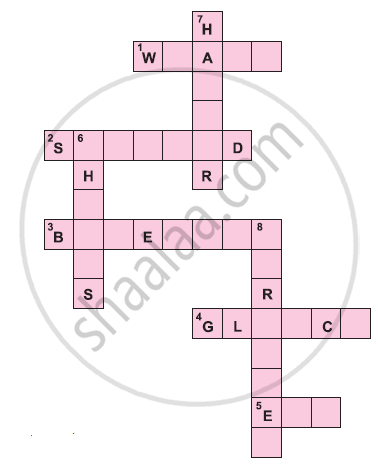
Across
1. very tired
2. had an angry look on the face
3. short trousers
4. a fault in a machine that prevents it from working properly
5. a small and naughty boy-fairy
Down
6. work that must be done every day, often boring
7. a basket with a lid
8. gave a short, high-pitched cry
Multiple Choice Question:
Who is the poet of this poem?
Answer the following question.
How do desert animals survive without water?
Your partner and you may now be able to answer the question.
Who is the speaker in the poem? Who are the people the speaker meets? What are they doing?
What was Rasheed’s fault at the fair?
What is meant by a ‘game of chance’? What lesson did the narrator learn from his experience at the fair?
Fill in the blanks with the words given in the box.
| how, what, when, where, which |
"You should know ______ to talk and ______ to keep your mouth shut," the teacher advised Anil.
Complete the following sentence by providing a reason:
In the short story, The Sound Machine, Dr. Scott thought Klausner was ill when Klausner rang up the doctor because ______.
