Advertisements
Advertisements
प्रश्न
Answer the following question:
Why did Mir Jafar enter into a conflict with the English East India Company?
Advertisements
उत्तर
After the Battle of Plassey, the English East India Company became the real power. The company made demands which Mir Jaffar was unable to meet. Gradually, the Nawab’s treasury became empty. The company also started interfering in the day to day administration. Mir Jaffar was not happy with the company. The company deposed Mir Jaffar and made Mir Qasim, his son-in-law, the new Nawab of Bengal.
APPEARS IN
संबंधित प्रश्न
In 1717, the Mughal emperor granted the United East India Company the right to carry on duty-free trade in ______, ______, and ______.
Fill in the blank:
The French East India Company was established in __________.
Fill in the blanks:
Bengal in the 18th century was the _______ and the most _________ province in India.
Match the Column:
| Column A | Column B |
| 1. Carnatic Wars | (a) Warren Hastings |
| 2. Farman | (b) duty-free trade |
| 3. Roberts Clive | (c) reconquered Calcutta |
| 4. Battle of Plassey | (d) Siraj-ud-Daulah |
| 5. Battle of Buxar | (e) Anglo-French rivalry |
| 6. Governor of Bengal | (f) Mir Qasim |
Answer the following question briefly:
The Battle of Plassey was a major turning point in the history of India. In this context answer the following question:
State the results of the Battle of Plassey.
Answer the following question briefly:
The Battle of Plassey was a major turning point in the history of India. In this context answer the following question:
Why is this battle considered a major turning point in the history of India?
This picture portrays a momentous event in 1765, involving a British Governor and a Mughal emperor wherein the Mughal emperor is conveying the grant of the Diwani to the governor.
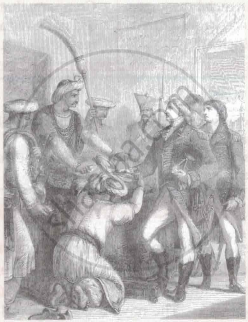
Give a brief account of the battle that preceded this event. When did it take place?
The battle of Plassey is a turning point in the history of India. Explain.
Answer the following question:
What were the causes of Conflict between Siraj-ud-daulah and the English?
Fill in the blanks:
The British had to face the challenge of the rulers of ________ and __________, ___________after the conquest of Bengal.
