Advertisements
Advertisements
प्रश्न
Answer the following question?
Describe the town planning and the drainage system of the Indus Valley Civilisation.
Advertisements
उत्तर
The cities were divided into two parts. The upper part called ‘citadel’ was built on a raised ground. It was inhabited by the upper class and had public buildings such as granaries. The lower part was inhabited by the common people. Each house had a courtyard, several rooms around it, a toilet, and a well. All the buildings were built of burnt bricks. Large blocks of houses were built along both the sides of streets. The roads were wide and straight and cut each other at right angles. Smaller streets led to bigger streets. The streets had lamp posts. The drainage system was of the highest order; even many of our present towns do not have such an excellent drainage system. House drains were connected to the street drains which joined the main drains which emptied outside the city limits. The drains were covered with stone slabs and had manholes at regular intervals. They were cleaned regularly. The Indus people were very conscious of hygiene and sanitation.
APPEARS IN
संबंधित प्रश्न
Answer the following question?
Describe the Great Bath. Where has it been found? What was it used for?
Answer the following question?
Describe the Great Granary. Where has it been found?
Fill in the blanks:
The Harappan seals are made of __________ and __________.
State whether the following is true or false.
The Harappans built strong boats.
Write a short note on the following:
Trade
Write True or False against the following statement
Hammurabi built the Hanging Gardens.
Text Book Keyword
Mulberry tree
Text Book Keyword
Porcelain
Fill in the blank.
The Mesopotamians kept a record of the business accounts on _______
Name the greatest contributions of the Mesopotamians in the field of architecture.
Write a short note on the following:
Script
Write a short note on the following:
Ziggurat
Choose the correct answer:
Ptolemy/Herodotus/Alexander called Egypt the ‘Gift of the Nile’.
State whether the following is true or false.
The city of Alexandria was founded by Alexander the Great.
Answer the following question briefly:
Why did the Egyptian civilization decline?
The figure on the right is of gods and goddesses.
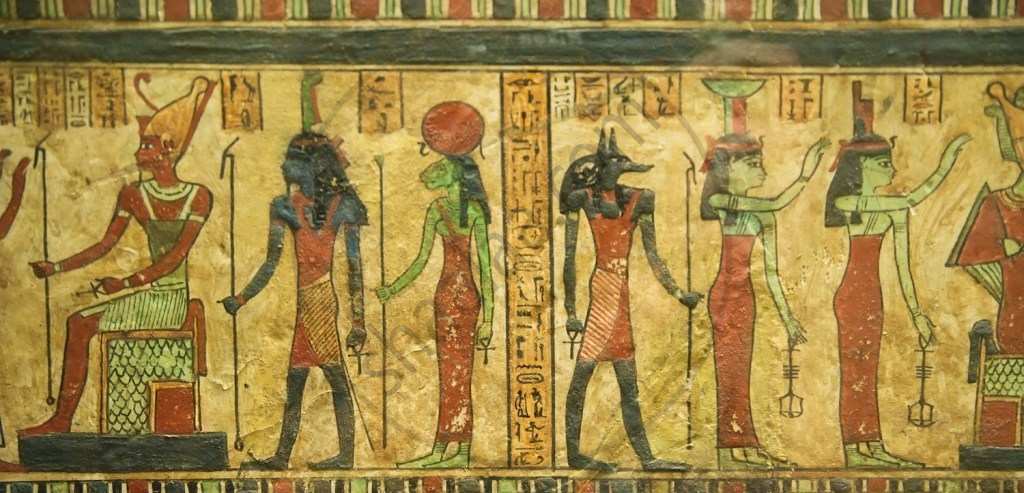
With reference to this civilization answer in one or two words.
(a) One of the Seven Wonders of the ancient world: ……….
(b) Embalming a corpse: …………………..
(c) Sun god: …………..
(d) God of the dead: ..............
Write a short note on ‘Great Bath’?
State whether the following statement is true or false:
The Chinese script is a form of picture writing.
