Advertisements
Advertisements
प्रश्न
Answer the following question briefly:
What was the position of the king in Egyptian society?
Advertisements
उत्तर
The king occupied the top position in Egyptian society. He had absolute powers over his people. People worshiped him as God and his statues were placed in temples. King’s achievements were described on their wails. The king was called the ‘ Pharaoh’.
APPEARS IN
संबंधित प्रश्न
Answer the following question briefly:
Describe the contribution of Egyptians in astronomy.
Answer the following question briefly:
What is Ziggurat? Describe it and give an example.
Write a short note on the Contribution of Mesopotamian in the field of science
Write a short note on The Great Pyramid
Picture study: This is a world-famous garden.
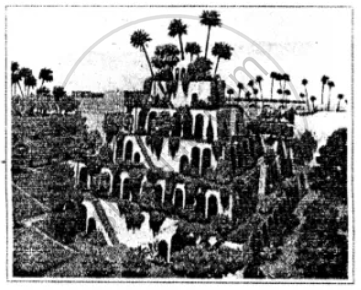
- Where and when was it built?
- Name the king who got it built.
- Why did he build it?
Fill in the blanks.
The two rivers associated with the Mesopotamian civilization were the _____ and the _______.
The staple diet of the ancient Egyptians consisted of ______ and ______.
Fill in the blank.
The chief occupation of the ancient Egyptians was ____________.
Fill in the blanks.
Two important gods of the Egyptians were ___ and _____.
Write a short note on the following:
Egyptian Script
Why were the vast majority of people in ancient China illiterate?
Fill in the blanks.
Mesopotamia is called the __________ and _________ of many civilizations.
Match the column.
| A | B | ||
| 1. | Civilization | a. | One of the seven wonders of the ancient world |
| 2. | Sumerian civilization | b. | temple-tower |
| 3. | Ziggurats | c. | representative of God on earth |
| 4. | Hanging Gardens of Babylon | d. | advanced system of social development |
| 5. | King | e. | world's first civilization |
Choose the correct answer:
The Mesopotamians are believed to be the first to cultivate barley/wheat/pulses.
Answer the following question briefly:
What were the main features of town planning in Mesopotamia?
What things proof of the technical knowledge and of the artisans Mesopotamians?
Describe the place of the king for Mesopotamians?
Text Book Keyword
Hieroglyphic Script
Name the state religion of ancient China.
Describe the town planning in ancient China.
